Identity is uncertain
Capture closed-cover labels, manufacturer and series names, catalogue or model information, service rating, visible breaker markings and approval labels, then have the installed enclosure and breaker combination confirmed.
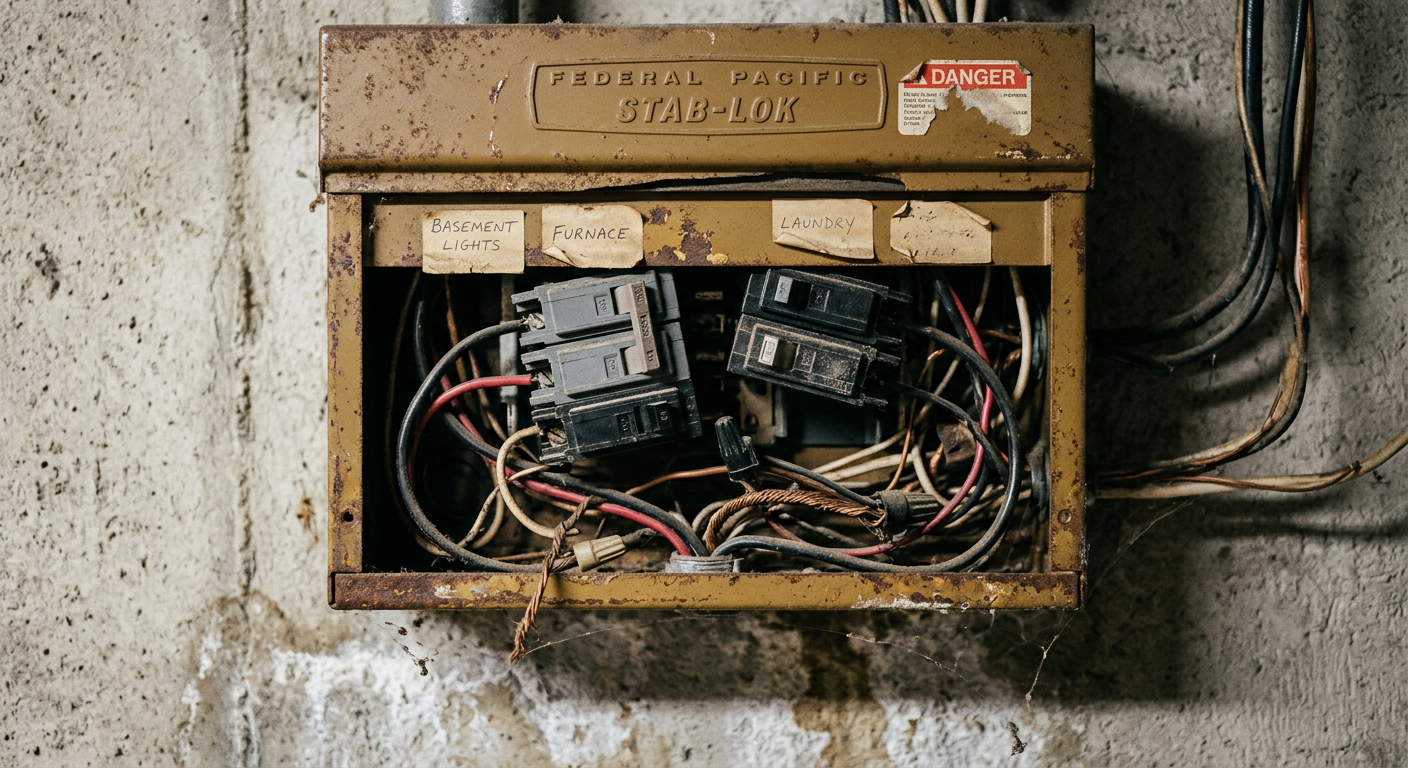
Canada homeowner planning guide
A Federal Pacific, Federal Pioneer or Stab-Lok label should trigger exact identification and a property-specific assessment, not an automatic remote diagnosis. The U.S. CPSC confirmed that breakers in its investigation failed certain calibration-test requirements; the investigation focused primarily on pre-1979 two-pole residential breakers and closed without determining the safety of FPE breakers or the accuracy of the manufacturer's position. Canadian authorities also document specific Stab-Lok breaker recalls, which are not a recall of every panel bearing the name. Technical Safety BC stated in 2026 that it does not require replacement based solely on manufacturer. The defensible decision combines exact equipment and recall identity, present condition, approved compatibility and parts, alterations, local requirements, planned loads and the insurer's current written position.
Do not remove the cover, disturb breakers or create an overload to test trip performance. Stop repeatedly resetting a tripping breaker. Smoke, flame, arcing, melting, a burning odour, severe heat, shock or water entry can require immediate emergency, utility and qualified-contractor action.
Short answer
Canadian electrical requirements are adopted and administered locally. This guide explains the durable planning questions; your province or territory, local authority, serving utility, equipment instructions, and responsible contractor determine the property-specific answer.
Find your jurisdiction guideFederal Pacific, Federal Pioneer and Stab-Lok names, handle colours and installation era are identification clues; the enclosure label, catalogue information, breaker models, ratings and approval marks define the actual equipment.
The CPSC investigation confirmed failures of certain UL calibration-test requirements and focused primarily on two-pole residential breakers manufactured before Reliance acquired FPE in 1979.
Closing the CPSC investigation was not a safety certification: the Commission said it did not determine the safety of FPE breakers or accept or refute the manufacturer's position.
ESA records specific Canadian Stab-Lok breaker recalls, including defined 1997 models and 2010 NA/NB models with stated date codes; that evidence does not establish a blanket recall of every Stab-Lok panel.
Technical Safety BC stated in its 2026 guidance that replacement is not required solely because of the manufacturer and recommends considering equipment age and condition, contractor assessment and insurer requirements.
Normal household operation and an outside visual review cannot prove how every breaker will respond under every overload or fault condition, and a panel replacement does not automatically increase service capacity.
Project triggers
Capture closed-cover labels, manufacturer and series names, catalogue or model information, service rating, visible breaker markings and approval labels, then have the installed enclosure and breaker combination confirmed.
Compare the exact breaker model and date code with current official Canadian recall records. Similar branding, handle colour or panel age is not enough to include or exclude a specific product.
Document reported trips and symptoms plus heat, corrosion, moisture, contamination, bus or enclosure damage, substituted breakers, poor terminations, missing fillers, double taps and unrecorded modifications.
Request the current property-specific condition in writing, including the accepted inspection, remedy, contractor qualification, deadline and records needed to close the file.
An EV charger, heat pump, suite, hot tub, solar system, battery or other renovation creates a separate capacity and circuit-design question that should be coordinated with the legacy-panel decision.
Confirm the panel and bus identity, exact breaker approval, manufacturer instructions, available approved products and local acceptance before treating a breaker swap as a complete remedy.
Decision guide
A defensible quote connects the existing condition and calculated demand to the proposed correction. It also separates contractor work, authority approval, and utility-owned scope.
Use the CPSC investigation's exact population and unresolved conclusion, Technical Safety BC's current manufacturer-neutral position and any model-specific Canadian recall. Do not turn any one source into a universal result.
Verify the enclosure, bus, main and branch breakers, catalogue numbers, ratings, approval information, recalled date codes, substituted components and modifications before choosing a remedy.
Tie each recommendation to observed damage, heat or moisture, incompatible or unsupported parts, recurring symptoms, branch-circuit defects, capacity needs, authority requirements or written insurer terms.
A defined repair or breaker correction depends on approved compatibility, suitable parts, undamaged retained equipment, local acceptance and whether the resulting installation resolves the documented finding.
State whether the project retains or changes the service rating, meter equipment, main protection, service conductors, overhead mast or underground route, grounding and bonding and utility connection.
Define permit and inspection status, equipment and breaker schedule, circuit directory, service rating, corrected findings, tests, photographs, insurer submission, warranty and invoice before work starts.
A Canada-wide installed price is not a substitute for a site-specific scope. Compare the same equipment, responsibilities, exclusions, and closeout standard.
Equipment identification, recall research, defined inspection scope, capacity work, insurer forms, photographs, reporting and return visits.
Enclosure, main and branch breakers, approved specialty protection, surge protection, disconnects, spaces, labels and product availability.
Damaged bus or conductors, unsupported breakers, short conductors, poor alterations, grounding and bonding, branch-circuit corrections and directory accuracy.
Same-capacity panel replacement versus changes to the meter base, main protection, service conductors, mast or underground route, grounding, utility design and connection.
Authority fees, utility isolation, outage duration, reconnect prerequisites, temporary power, repeat visits, corrections and delayed-restoration contingency.
Working-space correction, finished walls, cabinetry, siding, roofing, trenching, fire separation, hazardous materials and the agreed finish standard.
Do not schedule around an assumed installation day until equipment, permits, utility work, inspection, outage, and restoration dependencies are known.
From outside the closed cover, photograph labels and visible breaker markings and record the rating, circuit directory, symptoms, renovation history, previous reports, service information and insurer question.
Check the identified models and date codes against current Canadian recalls and read the CPSC record with its stated scope and limitations rather than relying on a generic brand list.
Have the authorized contractor document panel and bus identity, breaker compatibility, heat, moisture, corrosion, damage, modifications, conductor protection, grounding and bonding and connected circuit findings within the agreed scope.
Complete the capacity evidence needed for planned equipment and state whether the panel, main protection, meter, conductors, service route and utility connection remain or change.
Obtain the address-specific permit and inspection path, utility isolation or upgrade steps and current property-specific insurer or transaction requirements in writing.
Compare the same panel and breaker package, retained equipment, circuits, service work, utility, permit, outage, temporary power, restoration, exclusions, warranty, correction responsibility and change-order rules.
After accepted work, retain permit and inspection outcomes, equipment and breaker schedule, service rating, circuit directory, corrected findings, labels, tests, photographs, insurer submission, warranty and paid invoice.
Another qualified professional should be able to understand what existed, why the scope changed, who approved it, what was installed, and how the project closed.
Service rating, closed-cover equipment identification, observed condition, symptoms, accessible configuration, and the planned loads or project trigger.
Legal contractor, equipment, circuit and service work, permit holder, inspection, utility responsibilities, restoration, exclusions, and change-order rules.
Permit number where required, approved equipment, labelled circuits, documented changes, inspection milestones, and utility instructions where applicable.
Final acceptance or inspection status, equipment information, settings, warranty, utility records, paid invoice, and the responsible contractor's contact details.
Continue researching
Place Stab-Lok evidence within the broader legacy-panel decision framework.
Open guideRead the CPSC record and identification guidance in depth.
Open guideBuild a documented property-condition record.
Open guideDefine equipment, service and closeout scope.
Open guideSeparate trip diagnosis and compatibility from a generic breaker swap.
Open guideDistinguish spaces, distribution, load management and service capacity.
Open guideUse accepted load evidence to select service size.
Open guideDocument present and planned loads before ordering equipment.
Open guideMap meter, conductors, utility, outage and reconnection scope.
Open guideFind the current provincial or territorial permit, inspection and utility pathway.
Open guideTurn underwriting wording into a property-specific evidence scope.
Open guidePrimary references
Forms, code editions, inspection procedures, utility standards, equipment, and incentive programs can change. Verify the current local rule before relying on a project detail.
Canadian questions
No official Canada-wide rule cited here requires replacement solely by manufacturer. Use exact equipment identity, recall status, condition, compatibility, approved parts, alterations, local requirements, planned loads and current insurer evidence for the property decision.
CPSC testing confirmed failures of certain UL calibration-test requirements in an investigation focused primarily on pre-1979 two-pole residential breakers. The Commission closed the investigation without determining the safety of FPE breakers or accepting or refuting the manufacturer's position.
No. The CPSC's revised notice explicitly says the matter closed without a safety determination. It also does not establish that every breaker will fail. Preserve both limits when using the record.
The official Canadian records cited here identify specific models, production periods and date codes, not every Stab-Lok-branded panel. Match the exact product against the current recall source.
Use the closed-cover manufacturer and series labels, catalogue or model information, ratings, approval markings and visible breaker model information. Handle colour and house age are clues, not complete identification.
No. An outside visual review can identify labels and some warning signs, and a qualified internal assessment can document condition and compatibility, but normal operation and appearance do not prove every response under every overload or fault.
No. Do not create a fault or overload, open the panel or repeatedly reset a tripping breaker. Record the circumstances, disconnect problematic equipment when safe and arrange qualified diagnosis.
Underwriting varies by insurer, property and time. Obtain the actual insurer's current inspection, remedy, contractor and document requirements in writing instead of relying on a generic approval claim.
That depends on exact approved compatibility, available parts, bus and enclosure condition, alterations, connected defects and local acceptance. A generic breaker swap may not resolve a panel-level or insurance finding.
Not automatically. A same-capacity panel replacement can retain the existing service when accepted. A verified load need, service condition, utility requirement or planned electrification may support a separate capacity increase.
Cost depends on the panel and breaker package, circuit count, connected defects, same-capacity versus service-upgrade scope, utility work, permits, outage, access, restoration and closeout evidence. Compare normalized property-specific proposals.
Require identified findings, exact panel and breakers, retained equipment, circuit scope, service boundary, permit, inspection, utility work, outage, restoration, labels, tests, warranty and closeout records.
Property-specific next step
Send the property location, panel details, project trigger, planned loads, and timing. Provider availability, licensing, scope, price, permit responsibility, and utility scheduling are confirmed before work is booked.