Home purchase or sale
A buyer may need evidence about panel condition, service capacity, visible wiring, renovation history, insurance constraints, and likely project scope beyond a general home inspection.
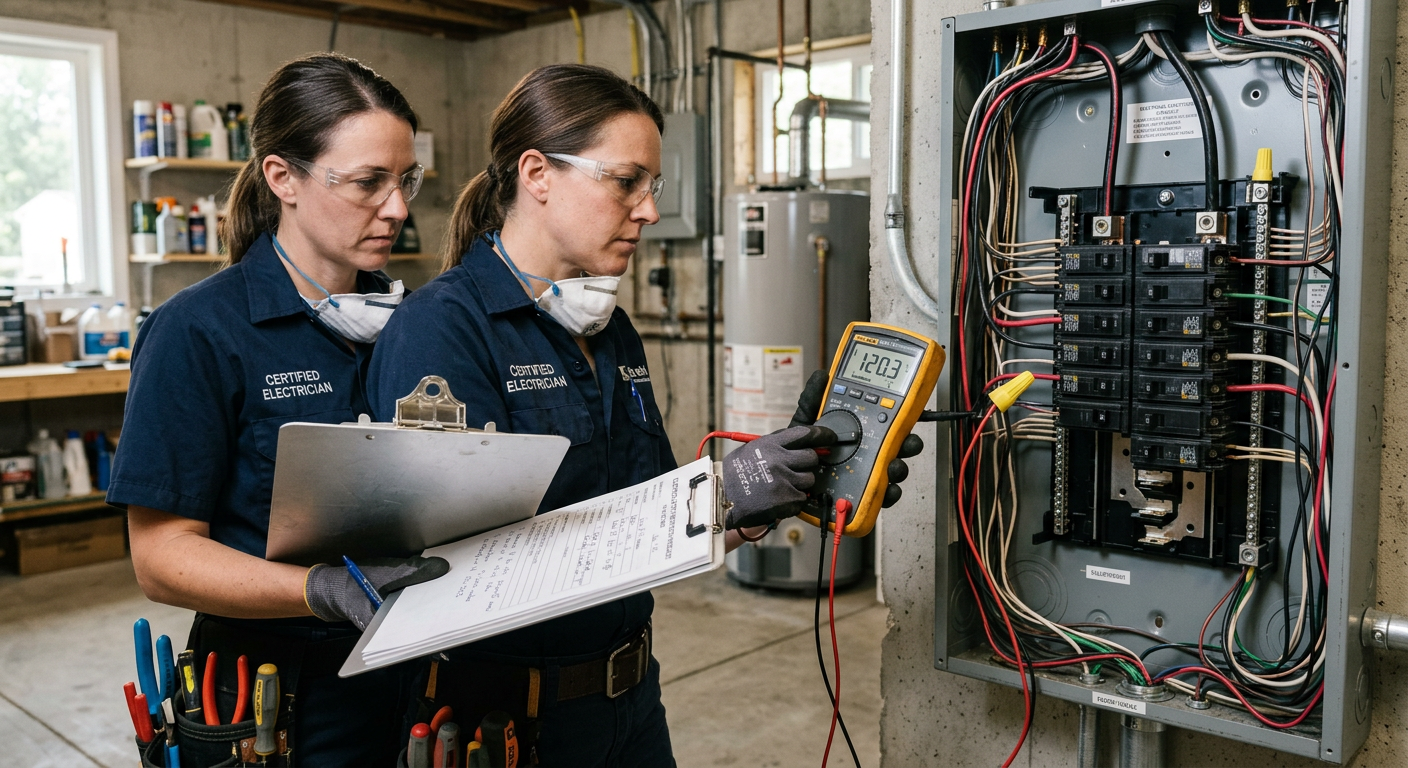
Canada homeowner planning guide
An electrical safety inspection in Canada is not one standardized service. It may mean an authority inspection of permitted work, a general home inspection, an electrician's defined condition assessment, an insurer-requested report, a forensic investigation, or verification after repairs. Choose the service by the decision it must support, then confirm the accepted credential, scope, access, tests, photographs, limitations, report format, corrective-work boundary, and final record in writing.
Smoke, fire, active arcing, severe shock, a burning odour with heat, downed conductors, flood-exposed equipment, and immediate danger are emergency conditions, not routine inspection bookings. Move away and contact emergency services or the serving utility from a safe location as appropriate. Do not remove a panel cover, touch damaged service equipment, reset a repeatedly tripping breaker, or energize equipment to gather evidence.
Short answer
Canadian electrical requirements are adopted and administered locally. This guide explains the durable planning questions; your province or territory, local authority, serving utility, equipment instructions, and responsible contractor determine the property-specific answer.
Find your jurisdiction guideA permit inspection evaluates regulated work within the authority's process; it is not a guarantee on every existing electrical condition in the property.
A general home inspection is primarily visual and non-invasive, while an electrical condition assessment can be scoped around specific equipment, symptoms, records, and qualified testing.
The report should state what was accessible, opened, operated, measured, sampled, excluded, or unsafe to inspect.
An insurer or lender decides which assessor, form, photographs, tests, wording, repairs, and closeout evidence it will accept.
Concealed wiring, intermittent faults, inaccessible equipment, sampling, and conditions that could not be safely tested remain limitations.
A useful finding connects observable evidence to priority and next action without presenting a sales recommendation as a regulatory order.
Project triggers
A buyer may need evidence about panel condition, service capacity, visible wiring, renovation history, insurance constraints, and likely project scope beyond a general home inspection.
A seller may want to identify visible hazards, incomplete work, insurance obstacles, missing records, or likely buyer questions before listing without turning the assessment into an unsupported whole-home certification.
Obtain the exact written requirement first. Accepted assessor, form, terminology, tests, photographs, corrective work, and closeout evidence vary by organization and property.
Repeated trips, flickering, heat, buzzing, odour, shocks, damaged devices, or unexplained outages need a focused diagnostic scope. A routine visual inspection may not reproduce or locate an intermittent fault.
Post-event work may require emergency isolation, utility coordination, an authority permit, equipment replacement, insurer evidence, and a defined path to safe re-energization rather than a normal maintenance report.
Older panels, unlabelled circuits, additions, suites, large new loads, suspected unpermitted work, or incomplete records can justify an assessment that separates condition, capacity, code-triggered work, and project planning.
Decision guide
A defensible quote connects the existing condition and calculated demand to the proposed correction. It also separates contractor work, authority approval, and utility-owned scope.
The electrical authority reviews permitted or notified work within its mandate and inspection process. Acceptance, a certificate, or permit closure should not be represented as certification of every existing, concealed, or unrelated condition.
A broad property inspection can identify readily accessible electrical concerns and recommend specialist review. Confirm the provincial licensing rules, contract, exclusions, and report standard; it is not automatically equivalent to opening equipment or completing electrical testing.
A qualified electrical professional examines an agreed system or decision question, records accessible observations and authorized tests, states limitations, and recommends next steps tied to evidence. This is often the appropriate path for panels, symptoms, prior work, capacity, or detailed due diligence.
The insurer or lender controls acceptance. Confirm the professional credential, form, wording, photographs, tests, remediation, and expiry or timing requirements before work.
A fire, failure, disputed cause, complex power-quality issue, legal matter, or specialized system may require an engineer, forensic specialist, laboratory, or other expert beyond a routine electrician or home-inspection scope.
A deficiency report does not itself prove that repairs were completed. Define who performs the work, whether a permit or reinspection is required, what evidence closes each item, and who receives the final record.
A Canada-wide installed price is not a substitute for a site-specific scope. Compare the same equipment, responsibilities, exclusions, and closeout standard.
A focused panel check, purchase assessment, insurer form, forensic investigation, whole-home review, or post-damage assessment requires different time, tests, and documentation.
Size, age, additions, panels, suites, outbuildings, commercial areas, generators, solar, batteries, wiring types, and prior alterations expand the accessible scope.
Cover removal, circuit tracing, thermal or electrical measurements, representative sampling, shutdowns, finished areas, occupied spaces, travel, and follow-up affect effort.
Missing permits, uncertain renovation history, intermittent symptoms, damaged equipment, disputed causes, multiple stakeholders, or a need to reconcile previous reports can add research and diagnostic time.
Emergency attendance, insurer deadlines, transaction conditions, utility isolation, tenant access, outbuildings, remote travel, engineer involvement, and return visits can materially change the fee.
Assessment fees should be separated from repairs, permits, utility work, reinspection, insurer documentation, engineering, and restoration so the recommendation remains auditable.
Do not schedule around an assumed installation day until equipment, permits, utility work, inspection, outage, and restoration dependencies are known.
State whether the assessment supports purchase, sale, insurance, renovation, capacity planning, symptom diagnosis, damage recovery, maintenance, permit closeout, or a dispute. One report should not silently be used for a different purpose.
Ask the buyer, insurer, lender, authority, lawyer, or project designer for its written credential, form, timing, evidence, and submission requirements before choosing the provider.
Identify the responsible professional and the included service, panels, accessible wiring, representative devices, grounding and bonding, protection, prior alterations, cover removal, tests, measurements, sampling, and exclusions.
Collect previous permits, inspection records, renovation documents, panel schedules, equipment information, symptom history, insurer instructions, and utility correspondence. The professional determines what can be accessed or de-energized safely.
Record the property, assessor, date, systems observed, equipment identification, operating conditions, authorized tests, measurements, photographs, inaccessible areas, unsafe conditions, and stated limitations.
Separate immediate hazards, required corrective work, further investigation, maintenance, capacity planning, record gaps, and monitor-only observations. Connect each recommendation to evidence and the decision it affects.
Where work is required, retain the contractor scope, permit or notification number, inspection status, changes, invoices, photographs, equipment records, and evidence that each specified deficiency was addressed or referred onward.
Another qualified professional should be able to understand what existed, why the scope changed, who approved it, what was installed, and how the project closed.
Service rating, closed-cover equipment identification, observed condition, symptoms, accessible configuration, and the planned loads or project trigger.
Legal contractor, equipment, circuit and service work, permit holder, inspection, utility responsibilities, restoration, exclusions, and change-order rules.
Permit number where required, approved equipment, labelled circuits, documented changes, inspection milestones, and utility instructions where applicable.
Final acceptance or inspection status, equipment information, settings, warranty, utility records, paid invoice, and the responsible contractor's contact details.
Continue researching
Coordinate a general inspection with specialist evidence, permit records, insurance, and offer decisions.
Open guidePrepare records and address buyer, insurer, and disclosure questions before listing.
Open guideConnect observed condition to repair, replacement, or monitoring decisions.
Open guideTranslate documented condition into panel, service, circuit, permit, and closeout scope.
Open guidePlan documentation around the insurer's stated acceptance requirements.
Open guideSeparate breaker condition from overloads, wiring faults, connected equipment, and compatibility.
Open guideSet emergency boundaries and post-exposure assessment and re-energization evidence.
Open guideRecognize symptom combinations that need urgent action instead of routine inspection.
Open guideUse demand evidence when the assessment must support new loads or service planning.
Open guideFind the permit holder, inspection stages, authority, utility boundary and closeout record for every Canadian jurisdiction.
Open guideKnow when an observation requires immediate safety action instead of a routine booking.
Open guidePrimary references
Forms, code editions, inspection procedures, utility standards, equipment, and incentive programs can change. Verify the current local rule before relying on a project detail.
Canadian questions
Cost depends on purpose, property size, panels, buildings, access, testing, cover removal, measurements, travel, report detail, insurer forms, and follow-up. Define the scope and deliverable before comparing quotes; a low price for a visual check is not comparable to a documented specialist assessment.
No. A permit or notification inspection reviews declared work within the authority's process and mandate. It should not be described as a guarantee that all existing, inaccessible, unpermitted, or concealed electrical conditions in the property are acceptable.
No. A general home inspector provides broad, primarily visual and non-invasive property observations under a contract. An electrical authority inspector works within a regulatory permit process, while an electrical contractor or specialist may perform a defined condition assessment or diagnosis. Licensing and scope rules vary by province and jurisdiction.
Possibly, but the insurer decides what it accepts. Obtain the written requirement and confirm credential, scope, form, photographs, tests, wording, corrective work, and submission process before booking.
No. Concealed wiring, inaccessible areas, intermittent faults, energized-system limits, sampling, and non-destructive methods create uncertainty. A credible report states those limitations and avoids absolute guarantees.
That depends on the agreed scope, safety conditions, authority, and assessor qualifications. Homeowners should not remove it themselves. The report should state which covers were removed and what remained inaccessible.
There is no universal Canadian checklist for every inspection purpose. A written scope may include service and panel identification, accessible condition, grounding and bonding observations, circuit protection, labels, representative devices, visible wiring, prior alterations, symptoms, approved equipment, records, authorized tests, photographs, limitations, findings, priorities, and next steps. Include only what the provider is qualified and authorized to assess.
A credible report should not make an unlimited guarantee. It answers a defined question within stated access, methods, timing, and limitations. Conditions can be concealed, intermittent, altered later, or outside the assessor's scope. Ask what the conclusion actually means and who accepts it.
No. Thermal imaging can document temperature patterns under the operating conditions present, but it does not by itself establish cause, conductor condition, connection integrity, breaker performance, capacity, or concealed wiring condition. It is one possible method within a qualified investigation, not a universal pass or fail test.
It may identify visible conditions or records gaps that suggest prior alterations, but appearance alone does not prove permit history. Compare available authority records, contractor documents, panel schedules, renovation history, and observed work. The local authority determines permit and compliance status.
It identifies the property, purpose, assessor, credential, date, scope, methods, accessible systems, observations, measurements, photographs, priority, limitations, referenced requirements, and recommended next steps. It separates evidence from sales conclusions.
It can, but substantial recommendations should remain evidence-led. Ask the report to separate observations from proposed work, compare the stated scope, and consider an independent second opinion for large or uncertain projects.
Property-specific next step
Send the property location, panel details, project trigger, planned loads, and timing. Provider availability, licensing, scope, price, permit responsibility, and utility scheduling are confirmed before work is booked.