One Level 2 EV charger
Use the charger's maximum or configured output, daily charging need, other household demand and approved EV energy-management options. The word Level 2 does not determine service size.
Canada homeowner planning guide
A 100A electrical service can be enough for a Canadian home when the accepted load calculation supports the existing and planned equipment. A 200A service provides more capacity for combinations such as EV charging, electric space and water heating, cooking, suites, hot tubs or workshops, but it is not an automatic requirement for every home. Decide from verified service information, exact equipment data, coincident demand, local rules, utility feasibility and the owner's future plan. Panel spaces, floor area and a meter marked 200A do not settle the comparison.
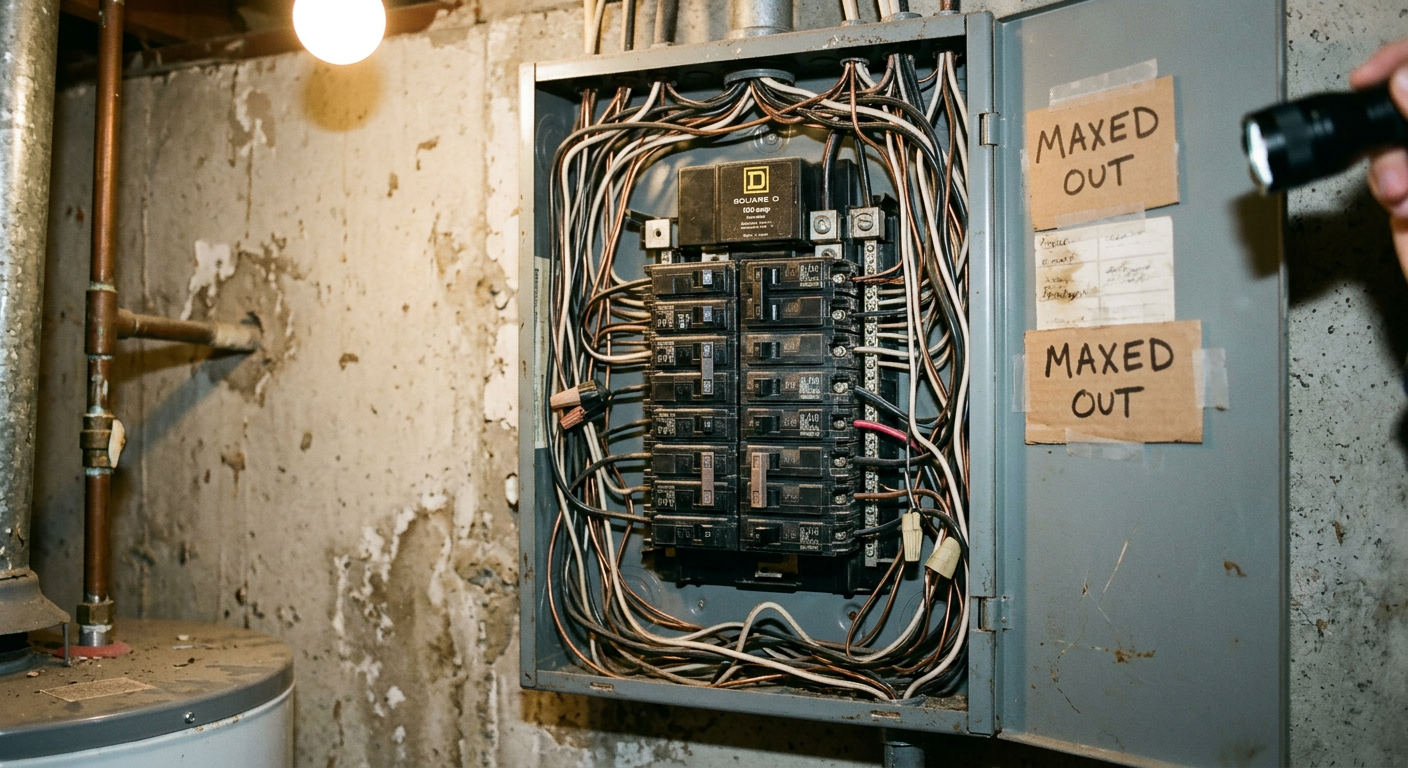
Do not remove panel or service covers, handle the meter, break utility seals, measure inside service equipment or increase breaker ratings to test capacity. Service equipment can contain energized parts even when the main breaker is off.
Short answer
Canadian electrical requirements are adopted and administered locally. This guide explains the durable planning questions; your province or territory, local authority, serving utility, equipment instructions, and responsible contractor determine the property-specific answer.
Find your jurisdiction guide100A and 200A describe service ratings; neither rating alone describes the home's actual demand, equipment condition or available breaker spaces.
Residential capacity is assessed with the load method accepted by the authority for the address, not by adding every branch-breaker handle.
A larger panel can add approved circuit spaces while retaining 100A service, so panel size and utility-supplied capacity must be kept distinct.
A meter marked 200A can be capable of measuring up to that value without proving the property has 200A service.
A 200A rating provides more headroom but does not guarantee unlimited future loads; new equipment still requires a suitable circuit and capacity review.
Approved load management can sometimes preserve 100A service by controlling flexible loads such as EV charging when household demand is high.
Project triggers
Use the charger's maximum or configured output, daily charging need, other household demand and approved EV energy-management options. The word Level 2 does not determine service size.
Include the outdoor unit, air handler, auxiliary or backup heat, existing heating retained, water heating and cold-weather operating sequence. The heat-pump name alone is not the electrical load case.
Cooking, laundry, heating, cooling, hot water and possible EV charging can stack with the main dwelling. A subpanel organizes circuits but does not increase total service capacity.
Induction cooking, a dryer, heat-pump water heater, sauna, hot tub or workshop may operate in different combinations. Finalize equipment and controls before choosing the service.
Limited spaces, damaged equipment or unavailable approved breakers can justify panel work even when 100A capacity is adequate. Condition and capacity are separate decisions.
Verify the complete service and collect the load assumptions behind upgrade claims. A 200A panel or meter label should not be marketed as proof of a finished 200A service.
Decision guide
A defensible quote connects the existing condition and calculated demand to the proposed correction. It also separates contractor work, authority approval, and utility-owned scope.
Confirm the main protection, panel or disconnect, meter equipment, service conductors and utility information as needed. Start the comparison with the actual property, not a listing description.
Use the locally accepted method and actual equipment data. Record heating, cooling, water heating, cooking, laundry, EV charging, suites, shops, hot tubs and other major loads.
Separate committed projects from speculative possibilities and state the years the design should accommodate. Paying for flexibility can be reasonable, but it should be an explicit owner decision.
Evaluate lower controllable-load settings, approved load management, equipment sequencing or retained fuel backup where these meet the owner's operating needs and local requirements.
A 200A design can affect the connection, meter, service wire, transformer or local network. Only the serving utility can confirm its requirements, available capacity and customer contribution.
Include customer and utility work, permits, outage, building restoration, equipment replacement timing, control limitations and future change costs rather than comparing panel prices alone.
A Canada-wide installed price is not a substitute for a site-specific scope. Compare the same equipment, responsibilities, exclusions, and closeout standard.
Costs may be limited to the required circuit, panel-space solution, equipment setting, calculation, permit and any focused correction when capacity and condition are adequate.
Approved controller, monitoring hardware, contactors or communications, installation, commissioning, failure behaviour, supported loads and future maintenance affect the alternative's total value.
Panel and main protection, meter socket, service conductors, mast or underground raceway, disconnect, grounding, bonding and circuit corrections can be part of the owner scope.
Design, transformer or network capacity, service wire, meter, pole or pedestal changes, disconnect, reconnect and customer contribution vary by utility and address.
Overhead clearance, roof and siding, underground conduit, trenching, concrete, landscaping, drywall, fire separation and hazardous materials can outweigh the panel difference.
Equipment replacement cycles, renovation sequence, outage, inspection corrections, utility lead time and the cost of revising a constrained design later belong in the comparison.
Do not schedule around an assumed installation day until equipment, permits, utility work, inspection, outage, and restoration dependencies are known.
Record the verified service, panel spaces and condition, heating and water-heating fuels, major equipment, renovation plans and service route without opening energized equipment.
Collect nameplate or design data, configured EV output, backup-heat stages, suite equipment and realistic operating requirements instead of using generic appliance labels.
Have a qualified contractor apply the load method accepted for the address and document assumptions, demand factors, controls and the resulting service requirement.
Price keeping 100A, adding approved load management or changing equipment settings against a complete 200A service design where each option is suitable.
Identify permits and inspections, then ask the serving utility about capacity, connection design, meter and service work, disconnect, reconnect, charges and lead time.
Choose the option that meets present demand, owner priorities and future horizon. Put ratings, equipment, controls, exclusions, restoration and contingency in the quote.
Keep the load calculation, service verification, utility response, equipment and settings, permit and inspection result, circuit directory, photographs, warranty and invoice for later projects.
Another qualified professional should be able to understand what existed, why the scope changed, who approved it, what was installed, and how the project closed.
Service rating, closed-cover equipment identification, observed condition, symptoms, accessible configuration, and the planned loads or project trigger.
Legal contractor, equipment, circuit and service work, permit holder, inspection, utility responsibilities, restoration, exclusions, and change-order rules.
Permit number where required, approved equipment, labelled circuits, documented changes, inspection milestones, and utility instructions where applicable.
Final acceptance or inspection status, equipment information, settings, warranty, utility records, paid invoice, and the responsible contractor's contact details.
Continue researching
Plan the complete project after 200A need is established.
Open guideUnderstand the accepted evidence behind the service-size decision.
Open guideCompare EVEMS, circuit sharing and controlled-load options.
Open guideSeparate breaker spaces, condition, controls and true service expansion.
Open guideChoose charging output and capacity strategy together.
Open guideInclude backup heat and controls in the electrical case.
Open guideCoordinate the main dwelling, suite loads and distribution design.
Open guideVerify the complete service and ownership boundaries.
Open guideMap utility, contractor, authority and owner responsibilities.
Open guideCompare larger service choices when 200A may not fit the long-term plan.
Open guidePrimary references
Forms, code editions, inspection procedures, utility standards, equipment, and incentive programs can change. Verify the current local rule before relying on a project detail.
Canadian questions
It can be. Use the load method accepted for the address, actual existing and planned equipment, service condition and suitable control options. House size, panel spaces or one new appliance cannot decide it alone.
No. Some homes and project plans fit a verified 100A service, while combinations of electric heating, water heating, cooking, EV charging, suites or other loads can support 200A or another design.
The service rating is twice 100A, but usable project capacity is not determined by simple subtraction alone. The accepted calculation, voltage and service design, continuous-load rules, existing demand and controls still apply.
Sometimes. Charging output, household demand, heating, service condition and approved EV energy management determine the design. A lower configured output can still meet many owners' daily charging needs.
Sometimes. Include the heat pump, air handler, auxiliary or backup heat, retained heating system, water heating and other household loads. Use exact electrical data and the intended cold-weather control sequence.
No. The calculation should include both dwellings' cooking, laundry, heating, cooling, water heating and other loads. A subpanel may organize suite circuits but does not add service capacity.
Not necessarily. Main protection, meter equipment, service conductors, overhead or underground service equipment and the utility connection must support the rating and required approvals must be complete.
Sometimes. A suitably rated panel can provide more approved spaces while the main protection retains 100A service. The design still requires suitable equipment, conductor protection and local approvals.
Sometimes. Approved controls can reduce, pause or prevent coincident operation of flexible loads. Suitability depends on actual equipment, local acceptance, product ratings, owner needs and safe failure behaviour.
It may be attractive to buyers planning electrification, but value is property- and market-specific. Accurate records proving the complete service, permits, inspection and condition are more useful than an unsupported panel-label claim.
There is no dependable national flat price. Customer service equipment, overhead or underground route, utility work, transformer capacity, permits, outage, circuit corrections and building restoration shape the total.
Ask for verified existing service information, the accepted load calculation and assumptions, exact equipment and settings, comparison of suitable alternatives, utility inputs, scope, exclusions and the final permit and inspection record.
Property-specific next step
Send the property location, panel details, project trigger, planned loads, and timing. Provider availability, licensing, scope, price, permit responsibility, and utility scheduling are confirmed before work is booked.