Skip to content
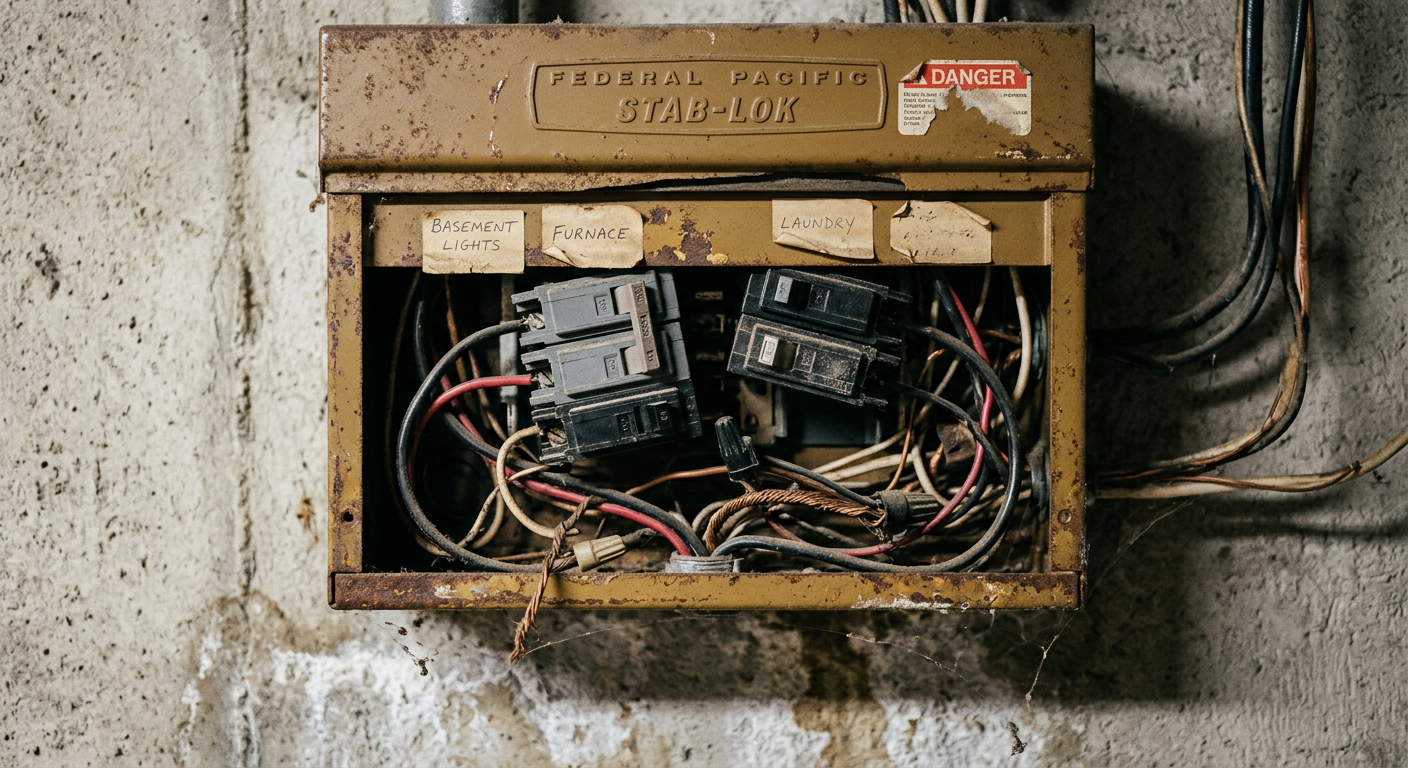
    Older Federal Pacific-labelled residential electrical panel

    Evidence-led Canadian guide

    Federal Pacific Stab-Lok Panels in Canada

    Identify the exact panel and breakers first, then combine the limited CPSC record with current condition, Canadian approval evidence and the insurer's written requirement.

    Citation-ready answer

    What the evidence supports

    Canada does not have one permit process, one utility standard, one service configuration, or one installed price. Durable answers distinguish the national planning principle from the local decision.

    Complete answer

    If a panel may be Federal Pacific or Stab-Lok, identify the exact manufacturer, model, labels and installed breakers, then obtain a qualified condition and compatibility assessment. The U.S. CPSC reported that testing confirmed certain breakers failed some UL calibration requirements, but closed its investigation without determining that the products presented a serious injury risk. That record is important evidence, not a remote diagnosis of every Canadian panel. Condition, approved parts, alterations, local requirements and the property insurer's written position determine the next decision.

    Federal Pacific, FPE and Stab-Lok names can appear on labels or equipment, but visual clues alone are not a complete identification.

    The CPSC says its investigation focused primarily on two-pole residential breakers made before 1979.

    The CPSC closed the matter without determining the safety of all FPE breakers and advised general breaker and fuse precautions.

    Insurer requirements are policy- and property-specific; obtain them in writing before choosing scope.

    Immediate safety note

    Do not remove the cover, test a breaker by creating an overload, or repeatedly reset a tripping device. Smoke, arcing, burning odour, melting, severe heat or water entry can require emergency action and utility or qualified-contractor involvement.

    01

    Identify the exact equipment

    Record closed-cover labels and property history before drawing conclusions from colour or age.

    Photograph the enclosure, door label, manufacturer name, catalogue or model information, service rating and visible breaker markings without removing the cover. Red handles or a broad installation era can support a question but do not establish the complete product identity.

    A qualified assessment can compare the enclosure, bus and breaker combination with approved equipment information and look for substitution, double taps, overheating, corrosion, contamination, damage and modifications. Record what is observed rather than applying a brand-only verdict.

    • Manufacturer, panel model and service rating
    • Breaker manufacturer, type and ratings
    • Approved-equipment labels and directory
    • Condition, modifications and available records
    02

    Read the CPSC record carefully

    The official record contains both confirmed calibration-test failures and an explicitly limited conclusion.

    The CPSC reported that many breakers did not fully comply with UL requirements and that Commission testing confirmed failures of certain calibration tests. It also said available data did not establish a serious risk of injury and closed the investigation without determining the safety of FPE breakers or the accuracy of the manufacturer's position.

    That wording does not support either extreme: claiming every Stab-Lok breaker will fail, or claiming the historical evidence is irrelevant. Use the exact CPSC scope, current condition and Canadian authority requirements to frame a property-specific recommendation.

    03

    Inspect condition and compatibility

    The assessment should connect each recommended correction to observable or documented evidence.

    Ask the electrician to document breaker compatibility, bus condition, overheating, conductor sizing, terminations, grounding and bonding, panel fill, circuit directory and any unsafe alterations. Breaker operation in normal use does not prove calibration under fault conditions.

    A replacement recommendation is stronger when it explains whether approved parts are available, whether the bus or enclosure is damaged, whether incompatible equipment is installed, and whether broader service or branch-circuit defects must be corrected with the panel work.

    04

    Handle insurance and property transactions

    Ask the actual insurer or underwriter for a written requirement tied to the exact equipment.

    Do not rely on a list claiming that every Canadian insurer refuses Stab-Lok panels. Underwriting rules, evidence requests and acceptable remedies vary by company, policy, location and time.

    For a purchase or renewal, share the equipment identity, qualified inspection findings, permit and correction records, and proposed scope. Make any condition of coverage, completion deadline or required document part of the transaction plan before committing to a repair or replacement.

    05

    Define repair or replacement scope

    Separate panel replacement from service upgrade and unrelated branch-circuit work.

    A panel replacement can retain service capacity while replacing the enclosure, bus and protective devices. A service upgrade may also involve the meter, conductors, mast or underground route, disconnect, grounding, utility design and outage.

    The quote should identify the exact approved panel and breakers, circuits and defects included, permit and inspection, utility responsibilities, outage, restoration, labels, testing, warranty and final documents. Avoid a fixed replacement price until those boundaries are known.

    06

    Verify Canadian approval and replacement parts

    A physically fitting breaker is not proof that it is approved for the enclosure or acceptable for the project.

    Ask for the enclosure label, breaker type and any manufacturer documentation supporting the installed combination. The Standards Council of Canada publishes recognized certification and inspection marks, but a mark must still apply to the exact product and use. Online listings, handle colour, marketplace descriptions and statements that a part is a replacement do not establish panel compatibility.

    Where a contractor proposes retaining the enclosure and replacing selected breakers, require the exact new part number, approval evidence, panel compatibility basis and an assessment of the bus and termination condition. Also ask whether the proposed part remains supported and reasonably available. A technically possible spot repair can still be a poor ownership decision if defects are broader or future compatible maintenance cannot be obtained reliably.

    07

    Create an insurer-ready condition file

    The report should answer the insurer's actual question without promising an underwriting result.

    Obtain the insurer's written request first. It may ask only for equipment identification, or it may require a qualified electrical condition report, specified correction, panel replacement, permit and inspection evidence, photographs, contractor invoice or completion by a deadline. Ask which credentials and report format the insurer accepts before paying for a deliverable that does not answer its requirement.

    A useful condition file identifies the property and service, panel and breakers, scope and limitations of access, visible and qualified-access findings, compatible-equipment basis, recommended corrections and photographs. Keep remediation pricing separate from the findings so the evidence remains clear. After work, add the permit and inspection outcome, new equipment schedule, labels, tests, utility record where applicable, warranty and paid invoice.

    08

    Use evidence in a purchase or sale

    A real-estate deadline does not convert uncertainty into a safe yes-or-no answer.

    For a buyer, record the exact equipment and obtain the insurer's position during the condition period when possible. Decide whether the transaction needs identification, a focused electrical assessment, a replacement proposal or completed permitted work. Include access, utility timing and restoration because a closing-date promise can fail when a panel project is actually a service change.

    For a seller, avoid advertising a panel as safe, recalled or fully remediated without evidence matching that statement. Provide available permits, inspection records, invoices and equipment details, and disclose the limits of any assessment. Credits and holdbacks are contractual decisions for the parties and their advisers; the electrical record should define the technical condition and proposed scope without pretending to decide coverage or transaction value.

    09

    Respond to symptoms without unsafe testing

    Hazard triage should reduce exposure and preserve evidence, not attempt to prove whether a breaker will operate.

    Smoke, flame, visible arcing, a strong burning odour, severe heat, shock, melted components, damaged service conductors or water at energized equipment can require emergency services, the serving utility and a qualified electrical contractor. Move people away from the affected area and follow responder instructions. Do not open the panel, touch metal enclosures, add water, reset devices repeatedly or create a test load. A hallway photograph is less important than keeping occupants clear of a suspected energized hazard.

    For intermittent trips, warmth, noise or flicker without an active emergency, record the affected circuit, loads operating, time, duration, weather or water context and whether the symptom is local or building-wide. Stop using equipment that appears damaged and arrange qualified assessment. The resulting report should distinguish appliance, branch circuit, breaker, panel, service and utility-side possibilities and should state any immediate restrictions while identification, compatibility and replacement decisions are completed.

    If temporary restrictions are recommended, write them by circuit or equipment and define who can remove them. Keep utility incident numbers, responder notes and photographs with the later inspection. When replacement follows, the new-work proposal should preserve the original cause investigation instead of treating removal of the old panel as proof that connected wiring, moisture, service damage or the initiating fault has also been resolved.

    Comparison

    Evidence for a Stab-Lok decision

    Treat the label as the start of an investigation, not the entire conclusion.

    QuestionEvidenceWhat it can establishWhat it cannot establish
    What is installed?Labels, model, breaker types and qualified reviewEquipment identity and compatibility questionsInternal condition from a hallway photo
    What did CPSC find?Official investigation noticeLimited historical scope and findingsStatus of every Canadian installation
    What is its condition?Documented electrical assessmentObserved damage, defects and modificationsFuture performance guarantee
    What does insurance require?Current written underwriting responsePolicy-specific evidence or workA national rule for all insurers
    What work is proposed?Itemized permit-ready scopePanel, service and circuit boundariesThat all old equipment needs the same project

    Verification ledger

    Separate identity, evidence and action

    The strongest recommendation does not leap from a brand name to a universal verdict. It traces the exact equipment, official record, current condition, Canadian approval context and property-specific stakeholder requirement.

    01

    Claim to test

    This is a Federal Pacific Stab-Lok panel

    Proof to request

    Closed-cover labels, catalogue or model information, service rating, directory, breaker markings and qualified confirmation of the enclosure and device family.

    Decision unlocked

    Whether the historical evidence and compatibility questions are relevant to this exact installation.

    02

    Claim to test

    The panel was recalled

    Proof to request

    A current Government of Canada recall or advisory record for the exact manufacturer, model and date, or another directly applicable official notice.

    Decision unlocked

    Whether a formal product action exists; the 1983 CPSC investigation notice alone is not a broad Canadian recall.

    03

    Claim to test

    The existing breakers are compatible

    Proof to request

    Enclosure labelling, breaker part numbers, recognized Canadian approval evidence, manufacturer documentation and qualified assessment of bus and termination condition.

    Decision unlocked

    Whether a targeted correction has a documented basis or replacement scope should be evaluated.

    04

    Claim to test

    Insurance requires replacement

    Proof to request

    Written direction from the actual insurer or underwriter naming the equipment, required provider, remedy, evidence and deadline for this property.

    Decision unlocked

    Which deliverable and completion sequence can be presented to the party that makes the coverage decision.

    05

    Claim to test

    Replacement requires 200 amp service

    Proof to request

    Accepted load assessment and written panel-only versus meter, conductor, route, disconnect and utility scope.

    Decision unlocked

    Whether condition can be addressed at the existing service rating or a separate capacity project is justified.

    Evidence to collect

    A useful project file lets another qualified professional understand the existing condition and the proposed decision.

    • Closed-cover manufacturer, model, rating and directory photographs
    • Breaker type, compatibility and available approved-part record
    • Bus, enclosure, heat, corrosion, damage and modification findings
    • Service, conductor, grounding, bonding and connected-defect scope
    • Written insurer or transaction requirement for the exact property
    • Permit, inspection, utility, testing, labels and warranty closeout

    Questions for the written scope

    1. 01What exact panel and breaker models did you identify?
    2. 02Which observed defect or compatibility issue supports each correction?
    3. 03Is the quote panel-only or does it change the electrical service?
    4. 04Which circuit defects and restoration are included or excluded?
    5. 05Who obtains the permit and coordinates any utility outage?
    6. 06What documents will satisfy inspection and the insurer?

    Canadian questions

    Frequently asked questions

    Are all Federal Pacific Stab-Lok panels unsafe?+

    A brand-only statement is not a property assessment. The CPSC confirmed calibration-test failures in part of its investigation but closed without determining that FPE breakers presented a serious injury risk. Identify and assess the exact equipment.

    Did the CPSC recall Federal Pacific Stab-Lok breakers?+

    The cited CPSC notice describes a closed investigation, not a broad recall. It expressly says the matter closed without a determination about safety or the manufacturer's position.

    How can I identify a Federal Pacific panel?+

    Look only from outside the closed cover for Federal Pacific, FPE or Stab-Lok labels, model information and breaker markings. Have a qualified person confirm the exact enclosure and breaker combination.

    Do red breaker handles prove a panel is Stab-Lok?+

    No. Handle colour can be a clue, but the manufacturer, labels, model, breaker type and compatibility record are better evidence.

    Will Canadian home insurance cover a Stab-Lok panel?+

    Requirements vary. Ask the actual insurer or underwriter in writing what identification, inspection, correction and final documentation it requires for the property.

    Can individual Stab-Lok breakers be replaced?+

    That depends on exact approved compatibility, enclosure and bus condition, available parts, defects and authority requirements. Do not assume a breaker swap resolves a panel-level issue.

    Does replacing the panel require a service upgrade?+

    Not automatically. A same-capacity panel replacement and a service-capacity change are different scopes, although site condition or utility requirements can connect them.

    What should a Stab-Lok replacement quote include?+

    Require equipment and breaker schedule, circuit and defect scope, service boundary, permit, inspection, utility work, outage, restoration, labels, testing, warranty and closeout records.

    Are Federal Pacific and Federal Pioneer the same panel?+

    Do not treat brand names as interchangeable. Record the exact manufacturer, enclosure model, labels and breaker types installed in Canada, then apply official evidence and approval information to those products. Similar names or breaker appearance do not establish that every historical finding applies to every equipment family.

    Is there a Canadian recall for every Stab-Lok panel?+

    No broad recall should be claimed without an exact official record. Search the Government of Canada's current recalls and safety-alert database using manufacturer and model information. The cited U.S. CPSC notice describes an investigation with specific scope and limitations, not a universal Canadian recall.

    Can an electrician certify that a Stab-Lok panel is safe?+

    A qualified person can document identity, accessible condition, compatibility questions, defects, limitations and recommended work. No inspection can guarantee future breaker performance or bind an insurer. Ask for a clear condition report and evidence-linked recommendation rather than an undefined safe-panel letter.

    Should I test Stab-Lok breakers by overloading a circuit?+

    No. Do not create an overload or fault, repeatedly cycle a questionable breaker or remove the cover. Breaker and panel assessment requires appropriate qualified procedures and equipment. A breaker that appears to operate normally is not proof of calibration under all fault conditions.

    Can I sell a Canadian home with a Federal Pacific panel?+

    The electrical equipment, disclosure, insurance and contract questions are property-specific. Identify the panel, gather permits and assessments, obtain the buyer's or insurer's current requirements and define any correction accurately. An electrical article cannot determine legal disclosure duties or whether a lender or insurer will proceed.

    How urgent is Federal Pacific panel replacement?+

    Urgency follows observed condition and current stakeholder requirements, not the brand name alone. Smoke, arcing, burning odour, melting, severe heat, water or energized metal require immediate safety action. Without those signs, arrange timely qualified identification and assessment and avoid unapproved alterations while scope is decided.

    What new panel should replace a Stab-Lok panel?+

    Select approved equipment from a service, load, circuit, space and future-use plan. Compare bus and main ratings, breaker availability, protective functions, enclosure size, warranty and local support. The best replacement is not established by brand popularity alone, and a larger panel does not automatically increase service capacity.
    ElectricalPanels.ca is an education and request-routing platform. Before work begins, verify the legal contractor, applicable licence, insurance, permit holder, inspection responsibility, utility role, written exclusions, warranty, and change-order terms.

    Property-specific next step

    Planning electrical panel work?

    Send the property location, panel details, project trigger, planned loads, and timing. Provider availability, licensing, scope, price, permit responsibility, and utility scheduling are confirmed before work is booked.

    Scope-first project reviewNo DIY panel instructions