Skip to content
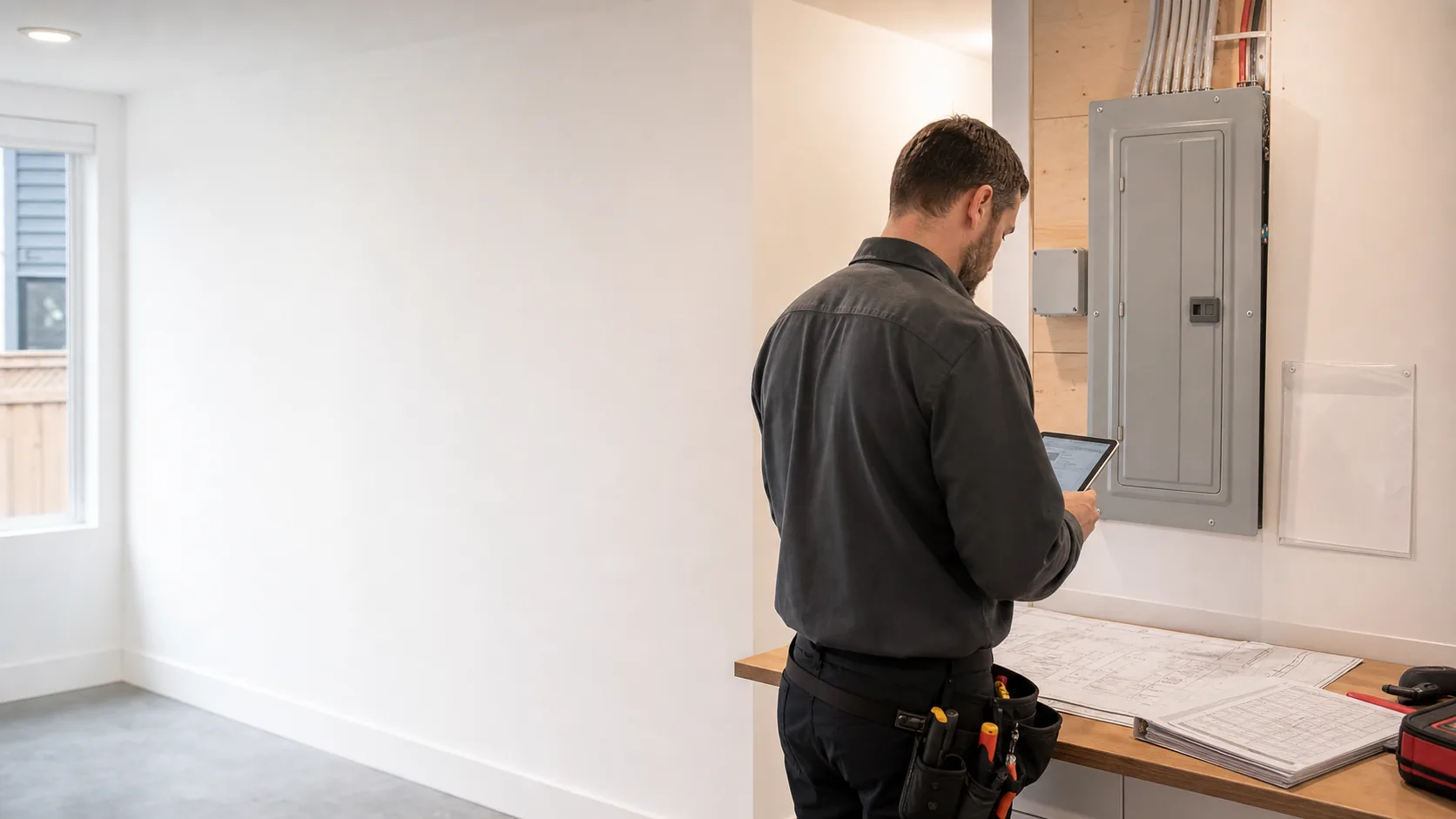
    Electrical professional reviewing panel plans and inspection records beside a closed Canadian residential panel

    Canada homeowner planning guide

    Electrical Panel Permits and Inspections in Canada

    There is no single Canada-wide electrical permit office or universal homeowner rule. Panel replacement, relocation, service upgrades, subpanels, major new circuits and generation work commonly enter a regulated permit, notification or inspection process, but the authority, eligible applicant, forms, fees and inspection stages depend on the property address and scope. Identify the provincial, territorial or delegated municipal authority first; identify the serving utility separately when metering, service equipment, capacity, isolation or reconnection is affected; and put the permit holder, inspection gates, deficiency process and final acceptance record in the written contract before work starts.

    Safety boundary

    Do not open service or panel equipment, remove a meter, break a utility seal, energize unfinished work or conceal wiring to keep a renovation moving. A main breaker does not isolate all service components. The authority, serving utility and qualified electrical provider determine the safe inspection, isolation and reconnection sequence for the address.

    Short answer

    What this project must establish

    Canadian electrical requirements are adopted and administered locally. This guide explains the durable planning questions; your province or territory, local authority, serving utility, equipment instructions, and responsible contractor determine the property-specific answer.

    Find your jurisdiction guide

    The Canadian Electrical Code is not a single national permit system; provinces and territories adopt and administer electrical requirements through their own legal and inspection frameworks.

    A building permit, electrical permit or notification, and utility service approval are separate processes even when one project needs all three.

    Homeowner-permit eligibility varies by jurisdiction and can depend on occupancy, dwelling type, rental or strata use, work scope and applicant qualifications.

    The responsible permit holder should be identified before work begins, and a homeowner should be able to verify the permit or notification through the issuing authority where records are available.

    Rough-in, service, concealment, connection and final inspection stages vary; work should not be covered or energized ahead of an authority or utility gate.

    Permit closure or inspection acceptance documents the declared work within that process; it is not a warranty that every existing or concealed condition in the property was assessed.

    Project triggers

    Situations that change the scope

    Panel replacement

    A like-rating panel replacement still alters regulated distribution equipment and protective devices. Confirm the permit or notification category, legal permit holder, outage, inspection and updated circuit-directory requirements instead of assuming same size means exempt.

    Service upgrade or relocation

    Increasing capacity or moving a panel, meter, mast, underground route or service equipment can require both electrical-authority and utility applications. One approval does not substitute for the other.

    Subpanel, feeder or major circuits

    A subpanel, garage or outbuilding feeder, EV charger, heat pump, hot tub, suite or other major circuit can trigger load evidence, equipment-location review, a permit and one or more inspection stages.

    Renovation or secondary suite

    Electrical work can run alongside building, development, fire, plumbing or gas approvals. Determine which work may be concealed, how life-safety systems are coordinated and whether separate authorities close each permit.

    Solar, battery or generator

    Generation, storage and standby systems can require electrical permits, one-line diagrams, utility interconnection or operating approval, transfer or isolation review, labels and witnessed or documented commissioning.

    Existing unpermitted or damaged work

    A condition assessment may identify visible concerns or records gaps, but the local authority determines the permit, investigation, correction and reconnection path. Do not treat a new permit as automatic approval of unrelated existing work.

    Decision guide

    Resolve the design choices before pricing

    A defensible quote connects the existing condition and calculated demand to the proposed correction. It also separates contractor work, authority approval, and utility-owned scope.

    01

    Correct authority for the address

    Find the province or territory, delegated municipality or inspection body that administers the electrical work. Municipal boundaries matter in places where the provincial safety authority does not issue every permit.

    02

    Permit, notification or inspection category

    Describe the exact panel, service, feeder, circuit, generation and building scope. Ask the authority or eligible contractor which application and inspection path applies rather than relying on a generic permit label.

    03

    Eligible permit holder

    Confirm whether the contractor, homeowner, property owner, qualified worker or another party may apply for this property and scope. Hiring a contractor should not result in the homeowner quietly becoming responsible for a homeowner permit.

    04

    Authority versus utility work

    The electrical authority administers regulated installation work; the serving utility controls its conductors, metering, connection design, isolation, reconnection and energization conditions. Map both paths on service-affecting projects.

    05

    Inspection and concealment gates

    List required rough-in, service, connection, final or other declarations and inspections. Define who books each stage and what cannot be covered, occupied or energized until it is accepted.

    06

    Deficiencies and final evidence

    Set responsibility for corrections, reinspection, repeat utility visits and delay. Require the permit identifier, inspection or acceptance status, utility record where applicable, updated labels, tests, invoice and warranty at closeout.

    What changes the project cost

    A Canada-wide installed price is not a substitute for a site-specific scope. Compare the same equipment, responsibilities, exclusions, and closeout standard.

    Permit and review category

    Application class, declared value or equipment, plan review, amendments, inspection count, travel, reinspection and expiry or extension rules can affect authority fees.

    Design and supporting documents

    Load calculations, one-lines, site plans, equipment schedules, engineering, utility drawings, strata or owner approvals and existing-condition investigation add professional scope before installation.

    Utility applications and outages

    Service design, meter work, disconnect, reconnect, utility labour, customer civil work, site readiness, temporary needs and repeat visits should be separate from the electrical permit fee.

    Inspection sequencing

    Multiple stages, remote travel, occupied properties, tenant notice, weather, concealment holds and narrow utility windows can add visits and schedule risk even when the installation is straightforward.

    Deficiencies and existing conditions

    Damaged conductors, grounding or bonding issues, incompatible equipment, prior alterations, water entry, hazardous materials and inaccessible routes need a written investigation and change-order boundary.

    Building and restoration work

    Framing, fire-stopping, drywall, cabinets, siding, roofing, trenching, concrete, weatherproofing and finish restoration may sit under separate permits and contracts.

    A jurisdiction-ready project sequence

    Do not schedule around an assumed installation day until equipment, permits, utility work, inspection, outage, and restoration dependencies are known.

    1. STEP 1

      Define the complete project

      Record the property address, occupancy, existing panel and service information, exact equipment and circuits changing, planned loads, utility-facing work, renovation dependencies and desired completion date.

    2. STEP 2

      Find the issuing authority

      Use the official province, territory, municipality or inspection-body source for the address. Confirm the current application type, applicant rules, documents, fees, validity period and inspection stages.

    3. STEP 3

      Verify the responsible provider

      Check the legal contractor, licence or authorization required for the jurisdiction and scope. Put the permit applicant, permit fees, design responsibility, insurance, supervision and warranty in the proposal.

    4. STEP 4

      Open the utility path separately

      Where service, metering, capacity, utility equipment, isolation or reconnection is involved, identify the serving utility and obtain its application, design, site-readiness, outage and energization requirements.

    5. STEP 5

      Apply before regulated work starts

      Submit the accepted scope and supporting information before demolition, equipment installation or irreversible building work. Record the permit or notification identifier and approved changes.

    6. STEP 6

      Hold required inspection stages

      Coordinate rough-in, service, connection, concealment and final stages as applicable. Keep work accessible and provide safe access, declarations, drawings, equipment data and utility instructions.

    7. STEP 7

      Correct and authorize energization

      Document deficiencies, responsible corrections and reinspection. Complete every authority and utility prerequisite before reconnection or energization, with a contingency for missed windows or unresolved conditions.

    8. STEP 8

      Close and retain the file

      Keep the signed scope, permit or notification record, inspection acceptance, utility correspondence, equipment schedule, load or design evidence, updated circuit directory, test and setting records, photographs, invoice, warranty and contractor identity.

    Questions every written quote should answer

    • Which electrical authority issues the permit or notification for this exact address?
    • What application category applies to the panel, service, feeders, circuits and other work in this quote?
    • Who is legally eligible to hold the permit, and whose name will appear on it?
    • Can I verify the permit or notification identifier before regulated work begins?
    • Which drawings, load evidence, equipment data, owner approvals or utility documents are required?
    • Which rough-in, service, concealment, connection and final inspections or declarations apply?
    • Does the utility need a separate application, design approval, disconnect, meter visit or reconnect authorization?
    • What cannot be concealed or energized before each approval, and who books every stage?
    • Who pays for corrections, reinspection, repeat utility visits, expired permits or missed scheduling windows?
    • Which final permit, inspection, utility, test, label, invoice, photograph and warranty records will I receive?

    Build an auditable project file

    Another qualified professional should be able to understand what existed, why the scope changed, who approved it, what was installed, and how the project closed.

    Existing condition

    Service rating, closed-cover equipment identification, observed condition, symptoms, accessible configuration, and the planned loads or project trigger.

    Approved scope

    Legal contractor, equipment, circuit and service work, permit holder, inspection, utility responsibilities, restoration, exclusions, and change-order rules.

    Installation record

    Permit number where required, approved equipment, labelled circuits, documented changes, inspection milestones, and utility instructions where applicable.

    Closeout file

    Final acceptance or inspection status, equipment information, settings, warranty, utility records, paid invoice, and the responsible contractor's contact details.

    Continue researching

    Related Canadian guides

    Alberta electrical permit guide

    Permits are administered through accredited municipalities or safety codes agencies. Calgary and Edmonton have their own processes; many other communities use an accredited agency.

    Open guide

    British Columbia electrical permit guide

    Technical Safety BC requires permits for regulated electrical installations and alterations in its jurisdiction. Burnaby, Maple Ridge, North Vancouver, Surrey, Victoria, Vancouver, and West Vancouver are among the jurisdictions that issue their own permits.

    Open guide

    Saskatchewan electrical permit guide

    Electrical permits cover new wiring and alterations to electrical installations. The permit holder is responsible for the declared work and required inspection process.

    Open guide

    Manitoba electrical permit guide

    The permit authority depends on location. Service equipment work is outside the scope of ordinary homeowner self-wiring and should be completed by a licensed electrician.

    Open guide

    Ontario electrical permit guide

    An ESA notification should be filed before work starts. A municipal building permit is not the same as an ESA electrical notification, and some projects may require both.

    Open guide

    Quebec electrical permit guide

    The contractor should confirm the declarations, municipal requirements, and distributor process that apply to the property and scope. Requirements differ from the ESA-style system used in Ontario.

    Open guide

    New Brunswick electrical permit guide

    Wiring permits are required before work starts for regulated installations. Inspection and plan-review requirements depend on project scope and risk.

    Open guide

    Nova Scotia electrical permit guide

    A wiring permit covers new electrical work and modifications to existing installations. Permit issuance and inspection are handled by the applicable utility inspection department.

    Open guide

    Prince Edward Island electrical permit guide

    A separate permit is required for each work site. The licensed electrical contractor applies and provides the required project and service information.

    Open guide

    Newfoundland and Labrador electrical permit guide

    The Government Service Centre administers permits and inspections. Panel, switchboard, generator, and large battery work falls within the regulated process.

    Open guide

    Yukon electrical permit guide

    Building Safety administers electrical permits. Inspection stages include rough-in, service wiring, and final finish, with advance notice required.

    Open guide

    Northwest Territories electrical permit guide

    Permits cover new installations, rewiring, and additions. Authorization is also required before power connection or concealment of rough wiring.

    Open guide

    Nunavut electrical permit guide

    Permit applications identify the contractor, registered electrical worker, work location, occupancy, service ampacity, voltage, and project value. Confirm the current form and fee with the territorial office.

    Open guide

    Alberta panel permit guide

    Review Alberta municipalities, accredited agencies, contractor scope, utility coordination and closeout records.

    Open guide

    Electrical safety inspections

    Separate permit inspection from a home inspection, condition assessment, insurer report or forensic investigation.

    Open guide

    Electrical service changes

    Map authority and utility responsibilities for meter, mast, underground route, capacity, outage and reconnection work.

    Open guide

    Electrical panel replacement

    Build a complete equipment, circuit, permit, outage, testing and closeout scope.

    Open guide

    Request a written assessment

    Submit the property and project details needed to identify the local approval path.

    Open guide

    Canadian questions

    Electrical permits and inspections FAQ

    Is there one electrical permit process for all of Canada?+

    No. Provinces and territories administer electrical requirements through different combinations of safety authorities, utilities, municipalities, delegated inspection bodies and territorial offices. Use the property address and exact scope to identify the current authority before work starts.

    Do I need a permit to replace an electrical panel in Canada?+

    Panel replacement commonly falls within regulated electrical work, but the application category, exemptions, eligible applicant and inspection process vary. Confirm the current rule with the authority for the address and identify the permit holder in the written contract.

    Does a same-size electrical panel replacement still need a permit?+

    Do not assume it is exempt because the service rating stays the same. Replacing distribution equipment changes protective devices, terminations and circuit connections. The local authority determines the permit or notification treatment for that scope.

    Is an electrical permit the same as a building permit?+

    No. An electrical permit or notification addresses regulated electrical work. A building or development permit addresses different building and land-use requirements. Renovations, suites and additions may need both processes plus other trade approvals.

    Is utility approval the same as an electrical permit?+

    No. The electrical authority administers the installation and inspection process. The serving utility controls its service, metering, connection design, equipment, isolation, reconnection and energization conditions. A service project can require both approvals.

    Can a Canadian homeowner obtain an electrical permit?+

    There is no national yes or no. Eligibility can depend on province, municipality, occupancy, dwelling type, rental or strata use, scope and applicant qualifications. Where a contractor is hired, verify whether the contractor must hold the permit.

    Should my electrical contractor pull the permit?+

    In many jurisdictions a licensed or registered electrical contractor obtains the permit or notification for contracted work. Rules vary, so verify the eligible applicant and ensure the contract names the permit holder rather than leaving responsibility unclear.

    When should I receive the electrical permit number?+

    Regulated work should not begin until the required application has been accepted under the local process. Ask for the permit or notification identifier and issuing authority before work starts, then retain it with the final inspection record.

    What electrical inspection stages can apply?+

    Depending on jurisdiction and scope, stages can include rough-in or concealment, service, connection or supply authorization, equipment-specific review and final inspection or declaration. Confirm the stages and booking responsibility before scheduling walls, occupancy or utility reconnection.

    Can electrical work be covered before inspection?+

    Not when the applicable process requires it to remain accessible for a rough-in, concealment or other inspection. Coordinate drywall, insulation, cabinets, fire-stopping and exterior restoration around the authority's accepted inspection sequence.

    Who arranges the power shutoff and reconnection?+

    The responsible electrical contractor commonly coordinates with the serving utility, but local processes differ. The quote should name the applicant, outage window, inspection prerequisites, utility charges, reconnect conditions and delay contingency.

    What happens if electrical work fails inspection?+

    The deficiency should be documented, corrected by the responsible qualified party and reinspected or otherwise cleared through the authority's process. The contract should explain correction costs, repeat visits, utility rescheduling and who communicates closure.

    Does a final electrical inspection approve the whole house?+

    Not automatically. Permit closure or inspection acceptance relates to the declared work and the authority's mandate. It should not be described as a guarantee that every existing, concealed, inaccessible or unrelated condition in the property was assessed.

    Can I look up old electrical permits on a property?+

    Record access varies by authority. Contact the municipality, provincial or territorial safety body, inspection organization or records office for the address. Missing records do not by themselves prove that work was or was not permitted.

    What records should I keep after permitted panel work?+

    Keep the signed scope, contractor identity, permit or notification number, inspection or acceptance status, utility records where applicable, equipment and breaker schedule, updated circuit directory, load or design evidence, test results, photographs, change orders, invoice and warranty.
    Property-specific next step

    Planning electrical panel work?

    Send the property location, panel details, project trigger, planned loads, and timing. Provider availability, licensing, scope, price, permit responsibility, and utility scheduling are confirmed before work is booked.

    Scope-first project reviewNo DIY panel instructions