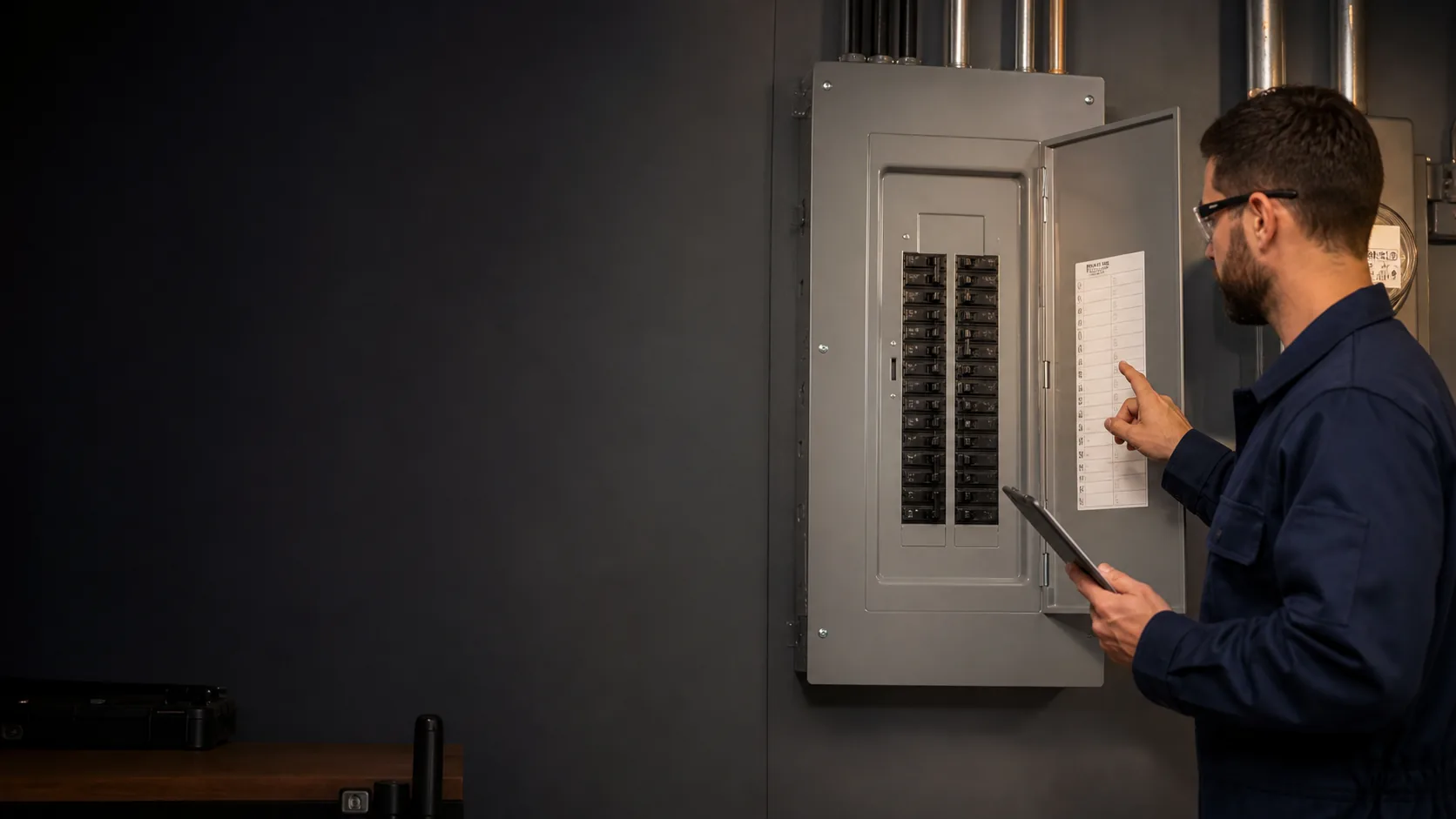
Electrical panels in Canada: the complete homeowner guide
Understand the panel, meter, service, breakers, ratings, capacity and safe ownership checks, then plan replacement, permits, utility work and electrification by jurisdiction.
Quick answer
Start with the problem, not the amperage
A residential electrical panel or load centre distributes electricity from an upstream service or feeder to protected branch circuits and other feeders. It is not the complete electrical service: the utility connection, meter and socket, service conductors, main protection, grounding and bonding, panel bus, breakers or fuses, subpanels, branch wiring and connected loads form related but distinct layers.
A panel replacement changes distribution equipment. Adding a subpanel changes distribution space. A service upgrade changes accepted supply capacity and can add utility, meter, conductor, grounding, outage and restoration work. Start with exact equipment identity, condition, ratings, circuit needs, calculated demand and local approval boundaries before selecting one of those scopes.
System anatomy
Follow electricity from the utility to each load
Homeowners often call the complete system "the panel." This map separates each layer so an assessment, quote or AI answer does not silently combine equipment, ownership and capacity that must be verified independently.
| System layer | What it does | Evidence to identify | Do not infer |
|---|---|---|---|
| 01Utility supply and point of connection | Delivers electricity to the property through the serving wire owner's network and defined connection point. | Serving utility, service voltage and phase, overhead or underground route, ownership boundary, connection standard. | A property-side panel rating does not prove the utility can provide a requested larger service. |
| 02Electricity meter and meter base | The meter records electricity use; the socket or base supports and connects it within the service arrangement. | Meter identifier, socket rating and condition, utility ownership rules, location and access requirements. | The removable utility meter and customer-owned meter socket are not the same equipment. |
| 03Service conductors and main protection | Carries supply to the service equipment and limits the installation through the main protective or disconnecting arrangement. | Verified service rating, conductor and raceway information, main-device rating, grounding and bonding, service standard. | Changing the distribution panel alone does not automatically change these service components or available capacity. |
| 04Main panelboard or load centre | Distributes power through buswork and approved protective devices inside an enclosure with covers and barriers. | Manufacturer, model, catalogue data, voltage, phase, bus rating, main rating, approved breaker family and circuit positions. | The panel bus rating, main-device rating and utility service arrangement can be related without being interchangeable. |
| 05Circuit breakers or fuses | Provides overcurrent and, where designed, additional protective functions for individual circuits or feeders. | Exact type and rating, panel compatibility, circuit purpose, trip history, required AFCI or GFCI functions, test records where applicable. | Adding breaker-handle ratings does not calculate service demand, and a trip is not proof that the panel is too small. |
| 06Feeders and subpanels | Extends distribution to another panel, floor, suite, garage, workshop or equipment group within upstream limits. | Feeder rating and route, upstream protection, downstream panel, neutral and grounding arrangement, loads, permit and labels. | A subpanel can add distribution positions but does not create more utility service capacity. |
| 07Branch circuits and connected loads | Supplies lighting, receptacles and fixed equipment according to the circuit design and connected use. | Circuit directory, conductor and protection information, equipment nameplates, controls, dedicated loads and planned additions. | Panel replacement does not automatically correct defects at devices, wiring, splices or appliances elsewhere in the property. |
Rating decoder
Six numbers that answer different questions
A 200A marking, a row of breaker handles and an empty circuit position are not a capacity calculation. Connect each marked value to the equipment and decision it actually governs.
Service rating
The accepted supply arrangement for the property, including main protection and related service equipment.
Verify withUtility and installation records plus qualified equipment verification.
Panel bus rating
The panelboard bus assembly's marked rating under the product and installation conditions.
Verify withExact panel label and manufacturer documentation.
Main-device rating
The rating of the main breaker, switch or protective device serving the panel or service arrangement.
Verify withDevice marking and complete service design, not appearance alone.
Branch-breaker rating
The protective rating for one circuit or feeder; it must suit the circuit and approved panel position.
Verify withBreaker, conductor, connected equipment and panel compatibility evidence.
Circuit positions
Approved physical locations for protective devices within the panel's marked configuration.
Verify withPanel directory, label, installed devices and manufacturer-permitted options.
Calculated demand
The demand established by the method accepted for the address and defined existing and planned loads.
Verify withCalculation or accepted usage-data record with assumptions and configured equipment inputs.
Safe ownership boundary
What a homeowner can monitor without opening the panel
These are recordkeeping and closed-cover observations, not instructions to test, clean or alter energized equipment.
- CHECK 01Keep the required access and working area clear; do not use the panel as a shelf or block its door.
- CHECK 02Keep the enclosure door and installed covers closed and intact; do not remove the deadfront for inspection photographs.
- CHECK 03Maintain a readable circuit directory that identifies actual areas and equipment rather than vague room labels.
- CHECK 04From outside only, note new odour, sound, unusual warmth, discolouration, corrosion, moisture, impact or loose equipment.
- CHECK 05Record which breaker operated, what was running, timing, weather and whether the event repeated; do not keep resetting it.
- CHECK 06Retain panel, breaker, permit, inspection, calculation, utility, warranty and modification records with the property file.
- CHECK 07Check exact identifiers against current official recalls; do not generalize one model notice to an entire brand.
- CHECK 08Use a qualified assessment when symptoms, damage, missing records, insurer questions or planned loads exceed safe closed-cover observation.
Decision framework
Five situations that look similar but price differently
Use this table to make quotes comparable. The cheapest line item is not useful when contractors are pricing different scopes.
| Homeowner situation | Likely project path | What must be verified |
|---|---|---|
| The panel is damaged, overheated, obsolete, or uninsurable | Panel replacement | Existing circuits, service size, equipment approval, permit, inspection |
| The home needs more total electrical capacity | Service and panel upgrade | Load calculation, utility capacity, meter and service equipment |
| The panel has capacity but no breaker spaces | Larger panel or sub-panel | Calculated load, feeder capacity, location, permit requirements |
| An EV charger or heat pump is being added | Load study before equipment selection | Nameplate loads, charging rate, auxiliary heat, load management |
| An insurer or buyer flagged the electrical system | Documented electrical assessment | Insurer's exact request, panel brand, wiring type, final records |
Responsibility map
Five parties can govern one panel project
A permit does not approve utility work, a utility design does not close the electrical permit, and an insurer request is not a technical diagnosis. Track each role separately so no approval or record disappears between quotes.
Property owner or project manager
Define the property, occupancy, symptoms, deadline, planned equipment, required operating conditions, and future loads. Provide access and retain the complete project record.
Electrical contractor or qualified designer
Identify existing equipment, assess condition, calculate or otherwise establish demand using the locally accepted method, develop the scope, obtain permits where eligible, install, test, and correct deficiencies.
Electrical permit and inspection authority
Administer the adopted electrical requirements for the location, determine permit and applicant rules, review required submissions, inspect regulated work, and record acceptance or deficiencies.
Serving electricity utility or wire owner
Control utility-owned conductors and equipment, service availability, metering, connection design, disconnect, reconnect, energization, site readiness, and utility charges where the project affects its system.
Insurer, lender, buyer, or property authority
State its underwriting, financing, transaction, condominium, strata, or property-management requirement. That requirement can affect scope but does not replace permit or utility approval.
Local verification
Province and territory guides
Each guide identifies the primary authority, permit model, utility role, housing context, electrification factors, planning questions, and official sources.
Alberta
Permits are administered through accredited municipalities or safety codes agencies. Calgary and Edmonton have their own processes; many other communities use an accredited agency.
British Columbia
Technical Safety BC requires permits for regulated electrical installations and alterations in its jurisdiction. Burnaby, Maple Ridge, North Vancouver, Surrey, Victoria, Vancouver, and West Vancouver are among the jurisdictions that issue their own permits.
Saskatchewan
Electrical permits cover new wiring and alterations to electrical installations. The permit holder is responsible for the declared work and required inspection process.
Manitoba
The permit authority depends on location. Service equipment work is outside the scope of ordinary homeowner self-wiring and should be completed by a licensed electrician.
Ontario
An ESA notification should be filed before work starts. A municipal building permit is not the same as an ESA electrical notification, and some projects may require both.
Quebec
The contractor should confirm the declarations, municipal requirements, and distributor process that apply to the property and scope. Requirements differ from the ESA-style system used in Ontario.
New Brunswick
Wiring permits are required before work starts for regulated installations. Inspection and plan-review requirements depend on project scope and risk.
Nova Scotia
A wiring permit covers new electrical work and modifications to existing installations. Permit issuance and inspection are handled by the applicable utility inspection department.
Prince Edward Island
A separate permit is required for each work site. The licensed electrical contractor applies and provides the required project and service information.
Newfoundland and Labrador
The Government Service Centre administers permits and inspections. Panel, switchboard, generator, and large battery work falls within the regulated process.
Yukon
Building Safety administers electrical permits. Inspection stages include rough-in, service wiring, and final finish, with advance notice required.
Northwest Territories
Permits cover new installations, rewiring, and additions. Authorization is also required before power connection or concealment of rough wiring.
Nunavut
Permit applications identify the contractor, registered electrical worker, work location, occupancy, service ampacity, voltage, and project value. Confirm the current form and fee with the territorial office.
National planning sequence
One workflow, locally verified at every gate
The sequence is durable across Canada even though the authorities, forms, contractor rules, utilities, and adopted requirements change by address.
- STEP 1
Identify the jurisdiction and utility
Use the property address to determine the province or territory, delegated municipality or safety authority, and serving electricity distributor. Do this before relying on permit forms, contractor rules, fees, or service standards.
- STEP 2
Define the problem and property
Record occupancy, panel and service labels, symptoms, visible closed-cover condition, service route, major existing loads, insurer or renovation requirements, and every planned EV, heating, suite, shop, solar, battery, or generator load.
- STEP 3
Separate condition, spaces, and capacity
Diagnose defects, identify approved equipment and parts, count usable circuit positions, and establish demand using the locally accepted method. A panel replacement, subpanel, load-management system, and service upgrade solve different problems.
- STEP 4
Confirm authority and utility scope
Establish the permit holder, supporting documents, inspections, utility application, customer and utility ownership boundaries, meter or connection work, disconnect, reconnect, site readiness, charges, and energization dependencies.
- STEP 5
Compare complete written proposals
Normalize equipment, circuit work, service work, permits, utility coordination, outage, restoration, tax, warranty, exclusions, allowances, deposits, and change-order rules. A low total is not comparable when key responsibilities are omitted.
- STEP 6
Close and retain the project record
Keep the signed scope, final invoice, permit identifier, inspection acceptance, utility correspondence, equipment and breaker schedule, updated circuit directory, calculation or design basis, settings, warranty, photographs, and responsible contractor information.
Topical authority map
Go from question to decision-ready scope
Panel replacement
Condition, obsolete equipment, insurance triggers, process, outage, and quote scope.
Read the guide100A to 200A planning
When additional capacity is justified and when load management may be enough.
Read the guideCanada pricing guide
Budget ranges, scope variables, permit costs, utility work, and quote comparison.
Read the guidePermit and inspection guides
Province-specific authorities, contractor rules, inspection records, and utility roles.
Read the guideEV and electrification readiness
EV charging, heat pumps, solar, batteries, suites, and winter peak demand.
Read the guideKnob-and-tube wiring
Active-circuit identification, condition, insurance evidence, rewiring, permits, finishes, and closeout records.
Read the guideGenerator and backup power
Transfer equipment, essential loads, panel integration, utility rules, commissioning, and safe operation.
Read the guideDirect answer library
Citation-ready answers to the questions homeowners ask before hiring.
Read the guideCanadian load reality
Winter peak matters more than a generic 200A recommendation
EV charging, electric resistance backup heat, water heating, ranges, dryers, hot tubs, suites, shops, and generators interact differently across Canada. Equipment nameplates and duty cycles should feed a load calculation. Breaker spaces alone do not prove available capacity.
What to send with an assessment request
- A photo of the closed panel cover and visible manufacturer label
- Your city, province or territory, and serving utility if known
- The equipment you plan to add, including model or nameplate details
- Any insurer, inspection, outage, or project-deadline requirement
Primary-source index
National references and jurisdiction authorities
The national references support the system, approval, safety and capacity model. The jurisdiction sources identify the first authority path for each province or territory. Open the local guide for its complete source set and current process.
National questions
Canadian electrical panel FAQ
These answers state the national planning principle. The linked jurisdiction guide, local authority, utility, equipment instructions, and responsible contractor govern the property-specific answer.
What is an electrical panel and what does it do?+
An electrical panelboard or load centre distributes electricity from an upstream service or feeder to protected branch circuits and other feeders. Its enclosure, buswork, main device where provided, breakers or fuses, barriers, labels and circuit directory form one part of the complete system; the utility connection, meter, service conductors and connected wiring remain separate layers.
Are electrical panel, breaker box, fuse box and load centre the same thing?+
They are overlapping homeowner terms, not perfect technical synonyms. Breaker box commonly means a panelboard using circuit breakers; fuse box describes older distribution equipment using fuses; load centre is a common product term for residential panelboard equipment. A project should identify the exact enclosure, protective devices and service arrangement instead of relying only on the nickname.
Is the electrical panel rating the same as the home's service rating?+
Not necessarily. The panel bus, main protective device, service conductors, meter equipment and utility connection each have relevant ratings and conditions. The complete accepted arrangement determines service capacity. A panel marked for a higher maximum rating does not prove the property is supplied at that rating.
Does adding all the breaker numbers show how much electrical service a home needs?+
No. Individual breaker ratings protect circuits and do not represent loads operating at maximum simultaneously. Service demand is established through the method accepted for the address using actual equipment, defined use, diversity or demand factors where applicable, and planned additions.
Can an electrician add a breaker whenever the panel has an empty space?+
An empty-looking position is only one check. The exact panel must permit the proposed breaker type and position, the circuit and protective functions must be designed correctly, calculated demand must remain acceptable, and local permit or notification requirements must be satisfied. Physical space does not prove electrical capacity.
Does switching off the main breaker make every part of the panel safe?+
Do not assume so. Equipment on the supply side of the main device can remain energized, and service configurations vary. The panel cover and barriers should remain installed; homeowners should not use the main switch as permission to remove covers, test conductors, tighten connections or alter equipment.
What electrical panel maintenance can a homeowner safely do?+
Keep access clear, the door and covers intact, and the circuit directory readable. From outside only, watch for moisture, corrosion, impact, unusual heat, sound, odour or repeated breaker operation and retain project records. Do not remove covers, spray cleaners, tighten internal parts or exercise protective devices unless the manufacturer or a qualified professional provides applicable instructions.
Is there one electrical permit process for all of Canada?+
No. Provinces and territories adopt and administer electrical requirements through different combinations of provincial safety authorities, utilities, municipalities, delegated inspection bodies, and territorial offices. Determine the authority for the property address and project scope before work begins.
Does every Canadian electrical panel replacement require a permit?+
Panel replacement commonly falls within regulated electrical work, but the permit category, applicant, exemptions, inspection process, and forms vary by jurisdiction. Verify the current rule with the local authority and identify the permit holder in the written contract.
Is panel replacement the same as a service upgrade?+
No. Panel replacement changes distribution equipment and can keep the same service rating. A service upgrade increases approved supply capacity and can involve main protection, service conductors, meter equipment, utility design, connection work, grounding, and a coordinated outage.
Does an EV charger require 200 amp service in Canada?+
Not automatically. Charging rate, daily driving, parking duration, existing demand, heating and hot-water loads, equipment settings, future loads, and approved load management affect the decision. Use the method accepted by the local authority before selecting service capacity.
Who arranges the power shutoff for panel work?+
The responsible electrical contractor commonly coordinates the required disconnect and reconnect with the serving utility, but local processes differ. The proposal should identify who submits the request, which inspections precede reconnection, expected outage, utility charges, and conditions that can delay energization.
Can a homeowner replace an electrical panel in Canada?+
Do not rely on a national yes or no. Homeowner-permit eligibility varies and can be restricted by scope, occupancy, dwelling type, rental use, shared walls, service equipment, or local rules. Main panel and service work requires qualified planning even where a limited homeowner path exists.
How should Canadian panel-upgrade quotes be compared?+
Compare the same service rating, panel and breaker equipment, circuit work, grounding and bonding, permit, inspection, utility application, meter and service work, outage, restoration, tax, warranty, exclusions, allowances, and final records. Confirm the legal contractor and change-order rules.
What records should be kept after electrical panel work?+
Retain the signed scope and invoice, contractor identity, permit number, inspection result, utility correspondence where applicable, equipment and breaker schedule, updated circuit directory, load or design records, final service rating, control settings, warranty, photographs, and change orders.
Get a decision-ready panel assessment
Tell us the location, panel concern, and planned electrical loads. We will confirm next-step availability and the information needed for an accurate local quote.