Breaker trips immediately
An immediate or forceful trip can indicate a short circuit, ground fault, damaged equipment, wiring fault, moisture, or another serious condition. Stop repeated resetting and arrange prompt qualified diagnosis.
Canada homeowner planning guide
A tripping circuit breaker is a protective response, not proof that the breaker has failed. The circuit load, connected equipment, conductors, terminations, moisture or damage, panel bus, and protective device should be assessed before replacement. Any new breaker must have the correct rating and function and be specifically approved for the exact panel and position. The work must follow manufacturer instructions and the local permit, inspection, and contractor rules.
Do not remove a panel cover, probe equipment, replace a breaker, or treat the main handle as proof that every service conductor is de-energized. For smoke, flame, arcing, burning odour, crackling, severe heat, shock, or water exposure, keep clear and use emergency services or the serving utility when appropriate. Do not force or repeatedly reset a breaker that trips immediately or will not remain set.
Short answer
Canadian electrical requirements are adopted and administered locally. This guide explains the durable planning questions; your province or territory, local authority, serving utility, equipment instructions, and responsible contractor determine the property-specific answer.
Find your jurisdiction guideRepeated tripping can reflect overload, short circuit, ground fault, arc fault, damaged wiring, a loose connection, moisture, connected equipment, or the breaker itself.
Physical fit does not prove that a breaker is approved for a panel, bus, location, or application.
Increasing breaker amperage without a verified circuit redesign can defeat conductor and equipment protection.
AFCI, GFCI, and dual-function devices protect against different conditions and cannot be removed merely to stop unwanted trips.
Tandem or quad breakers are permitted only where the panel labelling and approved equipment identify suitable positions and circuit limits.
Main-breaker symptoms can involve bus damage, service conductors, metering, utility coordination, or a panel-level correction rather than one branch circuit.
Project triggers
An immediate or forceful trip can indicate a short circuit, ground fault, damaged equipment, wiring fault, moisture, or another serious condition. Stop repeated resetting and arrange prompt qualified diagnosis.
A trip that follows specific appliances, simultaneous loads, heat, weather, or operating time can help separate excess demand, equipment failure, a connection problem, environmental exposure, and breaker behaviour.
The protective function, circuit wiring, shared or crossed neutrals, connected equipment, leakage, moisture, arcing conditions, manufacturer diagnostics, and locally required protection all matter before replacement.
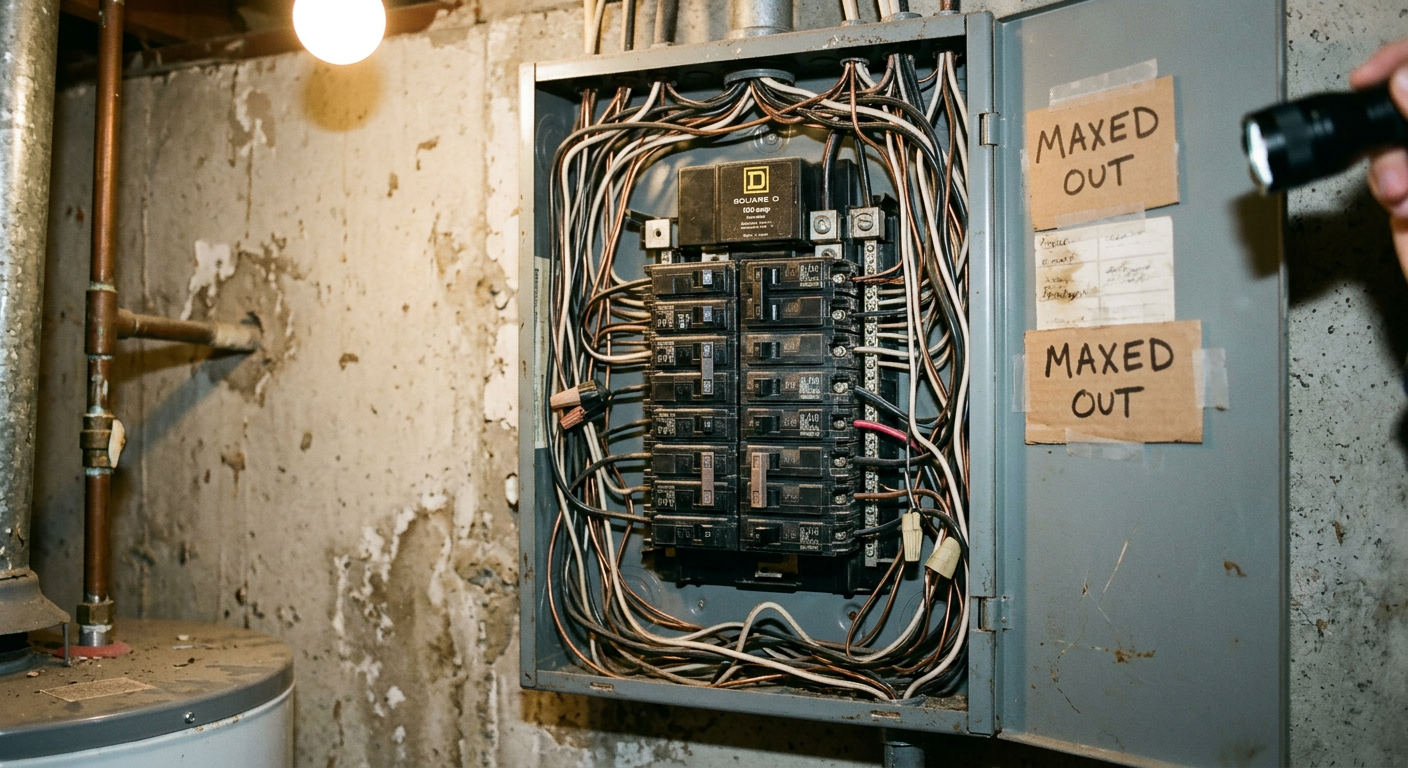
Unusual heat, buzzing, crackling, discolouration, melted material, looseness, or bus damage can extend beyond one breaker. Treat urgent symptoms accordingly and assess the panel and circuit as a system.
Missing labels, discontinued breakers, prior substitutions, modified retaining features, unavailable approved parts, or uncertain panel identity can turn a simple replacement into an equipment-support or panel decision.
Heating, cooking, pumps, air conditioning, workshops, suites, EV charging, renovations, and added receptacles can require a load or circuit redesign rather than a larger breaker or a space-saving device.
Decision guide
A defensible quote connects the existing condition and calculated demand to the proposed correction. It also separates contractor work, authority approval, and utility-owned scope.
Use the symptom pattern and qualified testing to distinguish circuit load, connected equipment, wiring, terminations, grounding, moisture, arc or ground-fault conditions, panel damage, and breaker operation.
Confirm poles, ampere rating, voltage, interrupting or series rating where applicable, conductor protection, load, trip function, AFCI or GFCI requirements, and any manufacturer-specific diagnostic features.
Use the exact panel catalogue and series information, panel labelling, breaker documentation, approved substitution or classification information, bus connection, mounting type, and authority requirements. Similar appearance is insufficient.
A sound panel and verified circuit may support direct replacement. Overload, damaged conductors, shared-neutral issues, moisture, equipment faults, incorrect wiring, or unsuitable protection require correction of the cause.
Main-breaker work can affect the service disconnect, panel bus, service conductors, meter or utility boundary, outage, permits, and replacement parts. Define those dependencies before treating it like a branch breaker change.
Bus damage, widespread overheating, corrosion, contamination, unsupported alterations, unavailable approved equipment, inadequate circuit positions, or multiple defects can justify a panel-level scope even when one breaker revealed the issue.
A Canada-wide installed price is not a substitute for a site-specific scope. Compare the same equipment, responsibilities, exclusions, and closeout standard.
Intermittent trips, multiple loads, appliance faults, shared neutrals, concealed wiring, outdoor moisture, and arc- or ground-fault investigations can take longer than a confirmed direct replacement.
Standard, two-pole, main, AFCI, GFCI, dual-function, shunt-trip, smart, and specialized breakers differ in cost and support. Obsolete or scarce approved parts can change the project path.
Overload, damaged cable, loose or overheated connections, equipment faults, neutral problems, moisture paths, improper extensions, or unsuitable protection can expand work beyond the breaker.
Damaged stabs, corrosion, contamination, heat damage, altered interiors, unsupported components, missing labels, or unavailable retaining parts can require panel repair, manufacturer review, or replacement.
Main-breaker work, occupied businesses, critical loads, restricted access, after-hours scheduling, utility disconnection, temporary arrangements, and repeat visits affect labour and continuity planning.
Permit or notification fees, inspection, testing, deficiency correction, travel, product sourcing, labels, documentation, cleanup, and warranty should be separated in a comparable quote.
Do not schedule around an assumed installation day until equipment, permits, utility work, inspection, outage, and restoration dependencies are known.
Keep clear of fire, smoke, arcing, shock, severe heat, burning odour, crackling, or water exposure and contact emergency services, the utility, or a qualified electrical contractor as the condition requires.
Without opening the panel, note the affected circuit, breaker markings visible from the closed front, timing, weather, recent work, connected equipment, simultaneous loads, sounds, odours, and whether the device trips immediately.
Identify the legally eligible contractor or permit holder, local permit or notification requirement, inspection path, panel manufacturer support, and utility involvement if a main or service interruption is affected.
The qualified assessment should address load, equipment, conductors, insulation, neutrals, grounding and bonding, terminations, moisture, breaker function, protective-device indications, bus condition, and prior alterations.
Specify the approved breaker and rating or the required circuit, equipment, connection, panel, or service correction. State why the chosen scope addresses the documented cause rather than only the symptom.
Complete the work under the accepted de-energization and manufacturer procedure, verify required settings and protective functions, test the affected circuit and loads, update labels and the circuit directory, and resolve inspection deficiencies.
Keep the breaker and panel identification, diagnosis, test outcome, corrections, permit or inspection status, product information, invoice, warranty, and instructions for escalation if the symptom returns.
Another qualified professional should be able to understand what existed, why the scope changed, who approved it, what was installed, and how the project closed.
Service rating, closed-cover equipment identification, observed condition, symptoms, accessible configuration, and the planned loads or project trigger.
Legal contractor, equipment, circuit and service work, permit holder, inspection, utility responsibilities, restoration, exclusions, and change-order rules.
Permit number where required, approved equipment, labelled circuits, documented changes, inspection milestones, and utility instructions where applicable.
Final acceptance or inspection status, equipment information, settings, warranty, utility records, paid invoice, and the responsible contractor's contact details.
Continue researching
Recognize smoke, arcing, heat, shock, water, and other conditions that should not wait for routine service.
Open guideSeparate ordinary equipment sound from escalating noise, odour, heat, and arcing indicators.
Open guidePlan assessment after leaks, condensation, flooding, corrosion, or environmental exposure.
Open guideDefine the observations, testing, limitations, findings, and records needed from an assessment.
Open guideReview panel condition, approved equipment support, circuit distribution, capacity, and replacement evidence.
Open guideCompare a focused breaker or circuit correction with a complete panel-only replacement scope.
Open guideUse accepted demand evidence when repeated trips or new loads raise a capacity question.
Open guideSeparate breaker positions, panel condition, load management, and a true service-capacity increase.
Open guideAssess exact equipment identity, present condition, approved parts, insurer requirements, and replacement paths.
Open guideFind the province, territory, authority, contractor, permit, and inspection path for the property.
Open guidePrimary references
Forms, code editions, inspection procedures, utility standards, equipment, and incentive programs can change. Verify the current local rule before relying on a project detail.
Canadian questions
Repeated tripping can reflect excess load, a short circuit, ground fault, arc fault, damaged wiring, a loose or overheated connection, moisture, a connected-equipment problem, an incompatible device, or a defective breaker. Record the pattern without opening the panel and arrange qualified diagnosis instead of repeatedly resetting it.
There is no reliable national price without the breaker type, panel model, diagnostic scope, circuit and bus condition, product availability, access, outage, permit or inspection, testing, travel, and required corrections. A quote for swapping a known compatible device is not comparable to one that identifies and fixes why it tripped.
Panel interiors can expose lethal energy, and service components may remain energized when a main breaker is off. Correct replacement also depends on diagnosis, product approval, circuit rating, mounting, manufacturer instructions, testing, and local permit rules. Use a legally eligible, qualified electrical contractor for panel work.
Not as a shortcut. The breaker protects conductors and connected equipment. A higher rating without a designed and verified circuit change can permit dangerous overheating. Diagnose the cause and verify conductor ampacity, equipment ratings, load, protection, and applicable rules before any rating changes.
Do not assume so. Similar size, shape, or the ability to connect to a bus is not approval. Confirm the exact panel catalogue and series, panel label, manufacturer documentation, breaker model and function, approved substitution or classification evidence, and any authority requirements for that installation.
A breaker that will not remain set may still be responding to a fault, damaged wiring, connected equipment, moisture, an incorrect neutral arrangement, heat damage, a panel problem, or an internal breaker condition. Do not force the handle or bypass the protection; keep urgent hazards clear and arrange diagnosis.
Ground-fault protection addresses certain leakage-current and shock hazards. Arc-fault protection detects specified arcing conditions associated with fire risk. Dual-function devices combine both. Required applications, wiring arrangements, diagnostics, and test procedures depend on the adopted local code and manufacturer instructions.
Do not remove required protection to stop a trip. The event may indicate a real fault, incompatible connected equipment, wiring or neutral issue, moisture, installation problem, or device condition. Confirm why the protective function operated and what the locally adopted requirements and manufacturer documentation require.
Only when the exact panel labelling and approved equipment permit that breaker type in the proposed position and the circuit design remains acceptable. A tandem adds circuit positions; it does not increase feeder or service capacity, and it is not a substitute for diagnosing overcrowding or load constraints.
Some temperature rise can occur under load, but unusual heat, odour, discolouration, buzzing, crackling, looseness, melting, repeated trips, or heat that differs sharply from comparable circuits warrants prompt qualified assessment. Do not remove the panel cover to investigate.
It can. Main-breaker work may affect the service disconnect, panel bus, customer-owned service conductors, meter or utility boundary, outage, reconnection, and permit or inspection sequence. Confirm the property-specific authority, utility, equipment, and de-energization responsibilities before ordering parts or scheduling work.
Not necessarily. A verified circuit, compatible approved breaker, and sound bus may support a focused correction. Panel replacement becomes more relevant with bus damage, widespread overheating, corrosion, contamination, unsupported alterations, unavailable approved equipment, inadequate distribution, or multiple defects.
Property-specific next step
Send the property location, panel details, project trigger, planned loads, and timing. Provider availability, licensing, scope, price, permit responsibility, and utility scheduling are confirmed before work is booked.