Skip to content
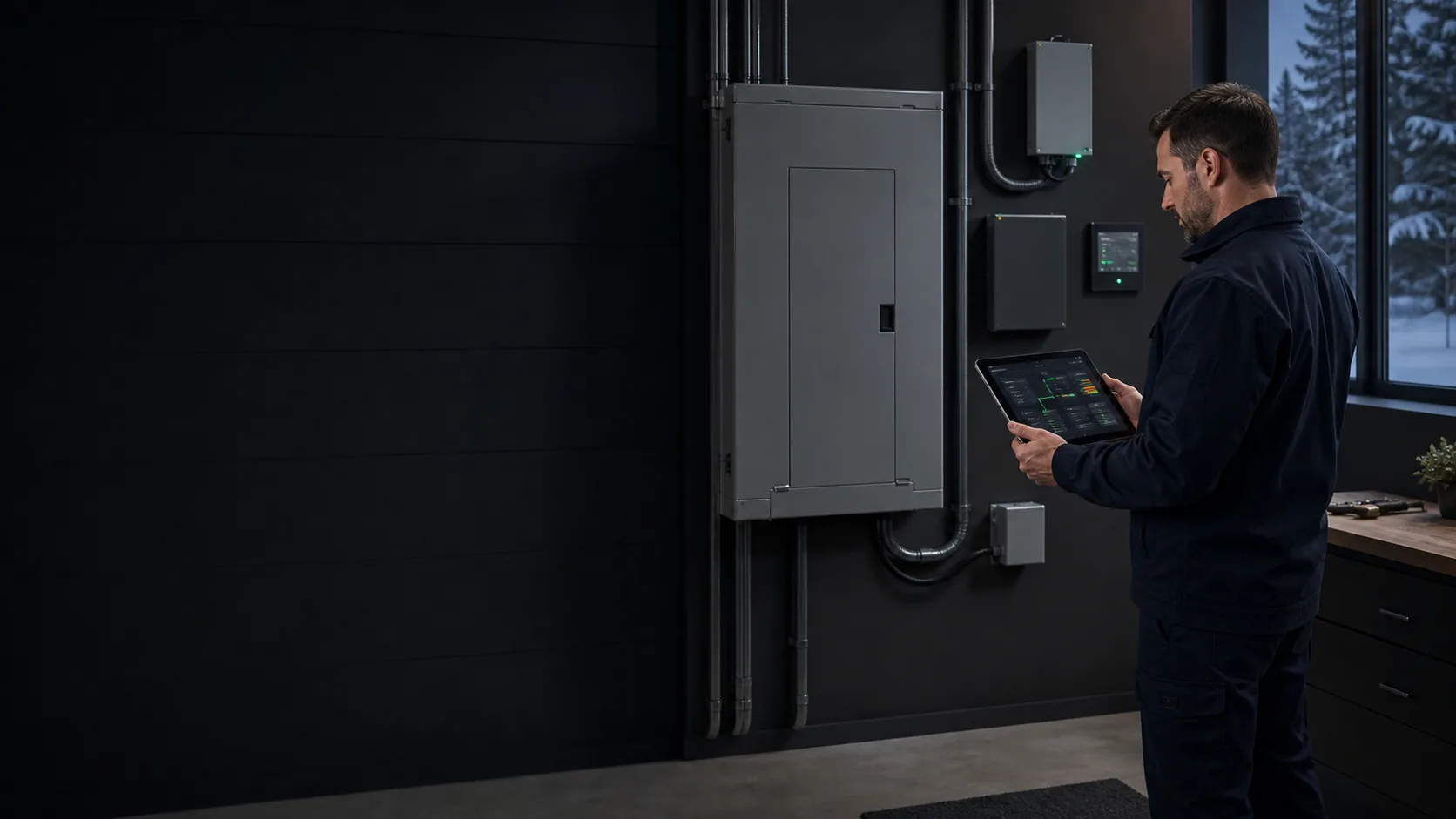
    Electrical professional commissioning a closed smart electrical panel and local home energy management controls in a Canadian utility room

    Canada homeowner planning guide

    Smart Electrical Panels and Energy Management in Canada

    A smart electrical panel can combine distribution equipment with circuit monitoring, selected remote control or coordinated load management, but those capabilities are not interchangeable and they do not automatically increase utility service capacity. Start with the problem to solve, then verify the exact Canadian-approved equipment, panel and breaker ecosystem, accepted demand-control function, local operation when internet or cloud services fail, solar or backup architecture, cybersecurity and privacy terms, software-support period, account transfer, permits, commissioning and a practical replacement path. A standard panel with a separate monitor or purpose-built controller can be the better design when it solves the requirement with less lifecycle dependence.

    Safety boundary

    Remote app control, a software off command or a load-shed state is not a safe-work isolation method unless the approved equipment and procedure explicitly establish it. Treat circuits and service equipment as energized, do not remove covers or utility seals, and use qualified electrical work practices and local approval processes.

    Short answer

    What this project must establish

    Canadian electrical requirements are adopted and administered locally. This guide explains the durable planning questions; your province or territory, local authority, serving utility, equipment instructions, and responsible contractor determine the property-specific answer.

    Find your jurisdiction guide

    Energy monitoring, remote circuit control, accepted load management and backup-load selection are four different functions.

    A dashboard that reports consumption does not prove that the system limits electrical demand or avoids a service upgrade.

    Canadian electrical approval applies to the exact product and installation; a U.S. listing, brand reputation or online compatibility claim is not enough.

    Internet, cloud, app and subscription failure should not defeat required electrical protection, local control or the documented fail-safe state.

    Circuit-level energy data can reveal occupancy and behaviour patterns, so account ownership, retention, sharing, deletion and transfer deserve written review.

    A smart panel does not make ordinary grid-connected solar power a home during an outage without approved isolation, transfer, inverter and backup architecture.

    Project triggers

    Situations that change the scope

    Understand where electricity is used

    A circuit or whole-home monitor can support diagnostics, rate planning and behaviour changes without replacing the panel. Verify measurement method, circuit coverage, data access and whether estimates are suitable for the decision.

    Add EVs or heat pumps on a constrained service

    A purpose-built, accepted energy-management design may limit flexible loads within a documented service boundary. Monitoring alone and ordinary schedules do not establish capacity.

    Coordinate solar and a home battery

    Define normal operation, export, charging, backup boundaries, transfer or isolation, low-battery state, black start, manual override and utility interconnection before accepting a compatibility badge.

    Prioritize circuits during an outage

    A smart backup controller can shed or sequence loads, but energy storage power, energy capacity, surge limits and critical-load requirements still govern what can run and for how long.

    Replace obsolete or damaged distribution equipment

    Panel condition, approved breakers, service rating, circuit count, outage, permit and correction scope should justify replacement. Smart features are a separate value decision, not proof that sound equipment must be replaced.

    Shift loads around time-based rates

    Automation can move EV charging, water heating or other flexible operation, but savings depend on the actual utility rate, household load profile, control limits and continued owner participation.

    Decision guide

    Resolve the design choices before pricing

    A defensible quote connects the existing condition and calculated demand to the proposed correction. It also separates contractor work, authority approval, and utility-owned scope.

    01

    Monitor or replace the panel

    Choose an add-on monitor when visibility is the objective and the existing equipment is suitable. Choose new distribution equipment only when the complete electrical and lifecycle case supports it.

    02

    Smart breakers or external controllers

    Compare circuit coverage, approved compatibility, switching duty, manual control, failure state, replacement parts and whether a dedicated controller solves the selected loads with less ecosystem lock-in.

    03

    Monitoring or accepted demand management

    State the electrical limit, monitored point, controlled loads, response behaviour and accepted calculation treatment. A display of demand is not the same as automatic control.

    04

    Cloud-dependent or locally functional

    Identify which protection, control, schedules, monitoring, backup and manual-override functions remain available when internet, cloud, account or vendor services are unavailable.

    05

    Integrated or modular architecture

    An integrated system can simplify one interface; a modular design can make individual controls, communications or distribution equipment easier to replace. Compare the expected service life of every layer.

    06

    Electrical product and data vendor

    Evaluate Canadian approval, warranty and electrical support separately from privacy, cybersecurity, software updates, subscriptions, data export, deletion and business-continuity commitments.

    What changes the project cost

    A Canada-wide installed price is not a substitute for a site-specific scope. Compare the same equipment, responsibilities, exclusions, and closeout standard.

    Distribution equipment and breakers

    Panel rating, spaces, breaker ecosystem, protective functions, controlled-circuit count, service equipment, surge protection, labelling and future parts availability.

    Sensors, controllers and communications

    Current transformers, gateways, relays, local controls, networking, signal coverage, cellular or cloud services, commissioning and integration hardware.

    Service and circuit corrections

    Existing panel condition, conductors, grounding and bonding, incompatible equipment, crowded circuits, water entry, prior alterations, service capacity and utility-facing work.

    Solar, battery, EV and backup integration

    Inverters, transfer or isolation equipment, critical-load design, export control, charger settings, managed loads, one-lines, utility applications and multi-vendor commissioning.

    Software and lifecycle obligations

    Subscriptions, extended support, firmware, replacement controllers, app-platform changes, installer access, cybersecurity maintenance, account recovery and end-of-service migration.

    Permits, outage and restoration

    Permit or notification, inspection, utility coordination, outage planning, equipment lead time, wall or finish repair, internet work, deficiencies, repeat visits and closeout documentation.

    A jurisdiction-ready project sequence

    Do not schedule around an assumed installation day until equipment, permits, utility work, inspection, outage, and restoration dependencies are known.

    1. STEP 1

      Write the problem statement

      Define the required outcome: identify loads, manage EV charging, limit demand, shift rate periods, select backup circuits, coordinate solar and batteries, or replace distribution equipment.

    2. STEP 2

      Document the existing electrical system

      Record service and panel ratings, exact equipment, approved breaker family, circuits, major loads, planned electrification, meter and service route, visible condition and prior permit records without opening energized equipment.

    3. STEP 3

      Compare the simplest suitable categories

      Price a standard panel, separate monitor, dedicated EVEMS, selected load controller, smart breakers, integrated load centre and service upgrade against the same stated objective.

    4. STEP 4

      Verify Canadian approval and design limits

      Confirm certification on the exact models, ratings, breakers, conductors, environment, accessories and installation instructions, then obtain the accepted load calculation and control boundary where capacity is involved.

    5. STEP 5

      Map every operating and failure mode

      Document normal, high-load, internet-off, cloud-off, sensor fault, controller fault, low-battery, outage, manual override, update and recovery behaviour before installation.

    6. STEP 6

      Review privacy, cybersecurity and lifecycle

      Identify collected data, storage location, sharing, retention, deletion, authentication, firmware updates, local network requirements, subscriptions, support horizon and what happens if the vendor or service ends.

    7. STEP 7

      Coordinate permits and integrations

      Have the responsible qualified party define the one-line, circuits, controls, solar, battery, transfer, EV, utility and permit or notification scope plus required inspection and interconnection gates.

    8. STEP 8

      Commission and transfer the system

      Test the documented control and failure modes, verify labels and settings, establish owner and installer accounts, remove temporary access and retain permit, inspection, one-line, configuration, recovery, warranty and data-transfer records.

    Questions every written quote should answer

    • Which exact problem does this system solve that a simpler monitor, controller or standard panel does not?
    • Which Canadian certification marks, exact models, ratings and breaker or accessory combinations apply?
    • What accepted calculation proves the claimed service-capacity or demand-management result?
    • Which loads are monitored, controlled, limited or shed, and at what electrical boundary?
    • What happens during internet, cloud, account, sensor, controller and communication failure?
    • Which functions remain available locally, and what physical manual control remains?
    • What solar, battery, backup, generator and EV operating modes are included and commissioned?
    • What energy and occupancy-related data is collected, where is it stored, who receives it and how is it deleted?
    • How long are firmware, security updates, cloud service, replacement parts and Canadian technical support committed?
    • Which subscriptions, rate-plan dependencies, third-party services and future fees are required?
    • Who holds the permit or notification, coordinates inspection and utility approval, and owns integration responsibility?
    • Which one-line, settings, fail-safe tests, account-transfer, recovery, permit, inspection and warranty records will I receive?

    Build an auditable project file

    Another qualified professional should be able to understand what existed, why the scope changed, who approved it, what was installed, and how the project closed.

    Existing condition

    Service rating, closed-cover equipment identification, observed condition, symptoms, accessible configuration, and the planned loads or project trigger.

    Approved scope

    Legal contractor, equipment, circuit and service work, permit holder, inspection, utility responsibilities, restoration, exclusions, and change-order rules.

    Installation record

    Permit number where required, approved equipment, labelled circuits, documented changes, inspection milestones, and utility instructions where applicable.

    Closeout file

    Final acceptance or inspection status, equipment information, settings, warranty, utility records, paid invoice, and the responsible contractor's contact details.

    Continue researching

    Related Canadian guides

    Electrical load management

    Compare EVEMS, circuit sharing, feeder monitoring and service-upgrade alternatives.

    Open guide

    Electrical load calculation

    Define the capacity evidence before accepting a management claim.

    Open guide

    Panel upgrades

    Separate distribution replacement, breaker space, controls and true service capacity.

    Open guide

    200A versus 400A service

    Compare larger service choices with managed demand and utility configurations.

    Open guide

    EV charger installation

    Translate daily energy needs into charging output and control requirements.

    Open guide

    Heat-pump electrical planning

    Include cold-weather and auxiliary-heat loads in the design.

    Open guide

    Solar and battery panel planning

    Map generation, storage, backup, transfer and interconnection boundaries.

    Open guide

    Electrical service changes

    Compare controls with permanent meter, conductor and utility work.

    Open guide

    New panel installation

    Plan equipment, circuits, permits, commissioning and closeout.

    Open guide

    Panel replacement

    Start with condition and equipment-support evidence before selecting smart features.

    Open guide

    Electrical permits across Canada

    Find the authority, permit holder and inspection path for the address.

    Open guide

    Electrical safety inspection

    Define the condition, capacity and documentation assessment boundary.

    Open guide

    Panel project pricing

    Compare electrical scope, technology, integrations and lifecycle costs line by line.

    Open guide

    Request a written assessment

    Submit the panel, loads, integrations and required outcomes for a documented scope.

    Open guide

    Canadian questions

    Smart panels and home energy control FAQ

    What is a smart electrical panel?+

    Usually it is distribution equipment that adds circuit monitoring and selected control, but the term is also applied to monitors, smart breakers and external energy-management controllers. Verify the exact electrical and software functions rather than relying on the category name.

    Is a smart panel the same as an energy monitor?+

    No. A monitor reports or estimates energy use. A smart panel may also control selected circuits, and an accepted energy-management system can limit defined electrical demand. Those claims require different evidence.

    Can a smart electrical panel increase service capacity?+

    It does not raise the utility service rating. Accepted load management can reduce or sequence selected demand within a documented design, which may avoid or defer a service upgrade in suitable projects.

    Can a smart panel avoid a 200 amp or 400 amp upgrade?+

    Sometimes, when the accepted load method, controlled loads, operating limits, equipment approval, fail-safe behaviour and local authority support the design. No smart-panel brand guarantees that outcome for every address.

    Can a smart panel add an EV charger to a 100 amp service?+

    It may be part of an accepted managed-charging design, but a service label and app feature are insufficient. Verify the EV energy need, charger setting, load calculation, monitored point, control response and fail-safe state.

    Does a smart electrical panel save electricity?+

    Monitoring and automation can help identify waste or shift flexible operation, but savings depend on household behaviour, utility rates, controllable loads and maintained settings. The hardware does not guarantee lower consumption or bills.

    Do smart panels work without internet?+

    Capabilities vary. Required electrical protection should not depend on a consumer internet connection, but monitoring, remote control, schedules, integrations or account access may. Obtain a function-by-function offline and cloud-outage statement.

    What happens if the smart-panel company shuts down?+

    The answer depends on local protective operation, manual controls, account architecture, firmware, replacement parts and whether installers can service the electrical system without the vendor cloud. Require an end-of-service and migration path before purchase.

    Are smart electrical panels secure?+

    Security varies by product and configuration. Review authentication, updates, encryption claims, local network design, remote installer access, incident response, support horizon and the functions exposed if an account or service is compromised.

    What privacy data can a smart panel collect?+

    Circuit-level patterns can indicate occupancy and equipment use. Review what is measured, where it is stored, sharing with third parties, retention, deletion, export, consent and account transfer using the vendor's current Canadian terms.

    Can a smart panel power a home from solar during an outage?+

    Not by itself. Outage operation requires an approved generation, inverter, isolation or transfer and often battery architecture designed for backup. The one-line and operating sequence must define what remains powered.

    Can a smart panel control a home battery or generator?+

    Some systems integrate selected products, but compatibility is not a complete design. Verify transfer and isolation, source ratings, supported loads, low-energy behaviour, manual control, commissioning and utility or permit requirements.

    Are smart panels sold in the United States approved in Canada?+

    Do not infer Canadian approval from U.S. availability. Verify a recognized Canadian certification mark on the exact product, accepted breaker and accessory combinations, ratings and local installation before purchase.

    How much does a smart electrical panel cost in Canada?+

    Cost depends on the panel and breakers, service and circuit work, monitoring and control hardware, EV, solar, battery or backup integrations, permits, outage, commissioning, subscriptions, restoration and support plan. Compare complete lifecycle scopes.

    What records should I receive after smart-panel installation?+

    Keep the load evidence and one-line, permit and inspection status, equipment and breaker schedule, control limits, offline and fail-safe test results, integration settings, owner and recovery accounts, privacy choices, warranty, update plan and paid invoice.
    Property-specific next step

    Planning electrical panel work?

    Send the property location, panel details, project trigger, planned loads, and timing. Provider availability, licensing, scope, price, permit responsibility, and utility scheduling are confirmed before work is booked.

    Scope-first project reviewNo DIY panel instructions