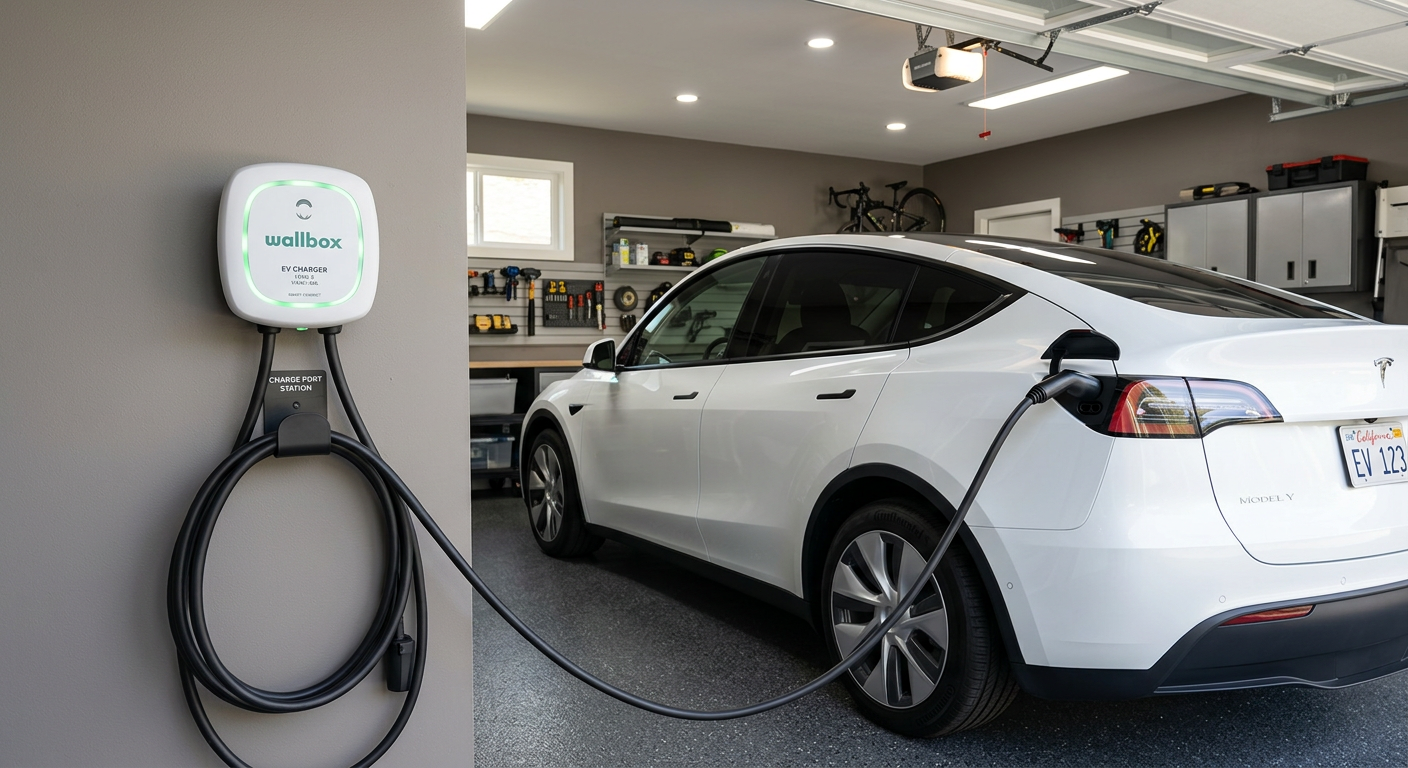
Attached-garage charging
Panel location, route through finished areas, charger placement, parking orientation, cable reach, network access, and available capacity determine whether the project is straightforward.
Canada homeowner planning guide
A home EV charging installation in Canada should be sized around daily energy replacement, the vehicle's onboard AC limit, parking time, location, electrical capacity, and local approval rules. Level 2 does not automatically mean a 50A circuit or 200A service. Before buying equipment, a qualified assessment should compare the lowest practical configured current, a dedicated circuit, an approved EV energy management system, and service work, then document the permit, inspection, settings, and final operating test.
Stop charging if there is smoke, sparking, melting, a burning odour, unusual heat, repeated protective-device operation, shock, water entry, or a damaged cable, connector, receptacle, or enclosure. Keep clear and use emergency services or the serving utility when conditions require them. Do not open the panel or EVSE, improvise an adapter, use an extension cord, defeat protection, or increase a field setting to troubleshoot.
Short answer
Canadian electrical requirements are adopted and administered locally. This guide explains the durable planning questions; your province or territory, local authority, serving utility, equipment instructions, and responsible contractor determine the property-specific answer.
Find your jurisdiction guideDaily energy replacement and available parking time usually matter more than the charger's largest advertised output.
The wall-mounted unit is electric vehicle supply equipment; the vehicle's onboard charger still limits the AC power it can accept.
A 100A service does not automatically require upgrading to 200A for Level 2 charging; an accepted load result must support the design.
A field-adjustable charging limit only supports the electrical design when the equipment, restricted setting, marking, and local acceptance requirements are satisfied.
A new charging circuit commonly requires a local electrical permit or notification and inspection, but the issuer and eligible permit holder vary by jurisdiction.
Outdoor and cold-climate installations need approved equipment, cable, mounting, water, snow, drainage, impact, and operating-temperature provisions for the actual location.
Project triggers
Panel location, route through finished areas, charger placement, parking orientation, cable reach, network access, and available capacity determine whether the project is straightforward.
Existing feeder capacity, garage panel condition, route, trenching, distance, voltage drop, grounding and bonding, communications, restoration, and future loads can make the feeder design more important than the charger itself.
Equipment approval, environmental and temperature ratings, cable reach, snow storage, drainage, sun, water, impact, mounting height, cord management, theft exposure, and vehicle position all belong in the site plan.
Ownership, board or strata approval, parking rights, shared electrical capacity, metering, billing, fire and building interfaces, network operation, maintenance, and an expansion roadmap require coordinated planning.
Two maximum-output circuits may be unnecessary. Compare daily energy, simultaneous parking, dynamic sharing, approved EVEMS, connector compatibility, cable reach, and what happens if one charger or network connection fails.
Ordinary charging, solar-aware charging, backup operation, and vehicle-to-home or vehicle-to-grid operation are different systems. Bidirectional equipment can trigger additional product, design, utility, protection, plan-review, and commissioning requirements.
Decision guide
A defensible quote connects the existing condition and calculated demand to the proposed correction. It also separates contractor work, authority approval, and utility-owned scope.
Estimate a typical high-driving day's energy from seasonal vehicle efficiency, then spread it across the reliable parking window. Check the vehicle's onboard AC limit; output above that limit cannot make that vehicle charge faster.
Compare the lowest setting that restores daily driving with circuit cost, charge time, service capacity, future vehicles, and operating preferences. The nameplate maximum is a product capability, not automatically the required design.
Compare product instructions, location, weather exposure, current, protective-device requirements, disconnecting means where applicable, receptacle configuration and duty, serviceability, portability, cord management, and local rules. Do not assume an existing appliance receptacle or adapter is suitable.
An accepted load assessment should compare lower charging current and approved EV energy management before a larger service is treated as the only path. Verify equipment acceptance, monitored point, fail-safe state, commissioning, locked settings, and maintenance responsibilities.
Confirm Canadian approval, vehicle inlet and adapter requirements, output, cable length, environmental rating, network dependence, local control, data access, subscription terms, software support, replacement parts, and warranty service.
Consider a second vehicle, dynamic sharing, panel pathway, conduit, parking assignment, interoperability, utility programs, software ownership, offline operation, and whether future bidirectional use is a real requirement or only a placeholder.
A Canada-wide installed price is not a substitute for a site-specific scope. Compare the same equipment, responsibilities, exclusions, and closeout standard.
EVSE model, configured output, hardwired or receptacle connection, cable length and management, environmental rating, network features, subscriptions, load sharing, and EVEMS affect equipment and setup.
Finished walls, conduit, cable length, detached garages, trenching, voltage drop, exterior penetrations, parking location, and restoration can outweigh the charger price.
Breaker space, calculated demand, feeder constraints, panel modifications, load management, meter or service work, and utility review can expand the scope.
Posts, bollards, wall reinforcement, weather seals, drainage, snow clearance, impact protection, cord storage, cable suspension, security, and durable mounting add site-specific work.
Engineering, board approvals, parking rights, common electrical rooms, shared feeders, metering, billing, networking, fire stopping, access control, commissioning, and future-port planning expand coordination.
Permit, inspection, utility or service work, condo documents, rebate conditions, engineering, network activation, field settings, testing, travel, and repeat visits should be explicit in the quote.
Do not schedule around an assumed installation day until equipment, permits, utility work, inspection, outage, and restoration dependencies are known.
Record each vehicle model, onboard AC limit, typical and high daily distance, seasonal efficiency, arrival and departure times, parking position, cable reach, and likely second-vehicle timing.
Document the service and panel, available spaces, garage feeder, parking geometry, route length, finished areas, exterior penetrations, trenching, restoration, environmental exposure, communications, and property or condo approvals.
Complete the jurisdiction-accepted load assessment using verified existing and planned loads. If capacity is constrained, compare a lower fixed setting, approved EVEMS, other load changes, or service work using the same charging requirement.
Specify the exact EVSE, configured current, connection method, circuit, conductors, protection, disconnecting means where required, EVEMS, labels, mounting, cable management, network, and future pathway.
Identify the permit or notification issuer, eligible holder, submissions, inspection, condo or building approval, utility involvement, rebate pre-approval, equipment lead time, outage, restoration, and who owns each task.
The responsible contractor follows the approved design, equipment instructions, permit conditions, and safe-work requirements. Complete required inspections and record any design or field-setting changes before energization or handover.
Verify vehicle charging, configured current, protective functions, EVEMS response and fail-safe state, labels, cable reach, network or offline operation, owner controls, product registration, inspection status, warranty, and final settings.
Another qualified professional should be able to understand what existed, why the scope changed, who approved it, what was installed, and how the project closed.
Service rating, closed-cover equipment identification, observed condition, symptoms, accessible configuration, and the planned loads or project trigger.
Legal contractor, equipment, circuit and service work, permit holder, inspection, utility responsibilities, restoration, exclusions, and change-order rules.
Permit number where required, approved equipment, labelled circuits, documented changes, inspection milestones, and utility instructions where applicable.
Final acceptance or inspection status, equipment information, settings, warranty, utility records, paid invoice, and the responsible contractor's contact details.
Continue researching
Compare controlled EV charging with a larger electrical service.
Open guideUnderstand the capacity evidence behind a charger setting, EVEMS, or service recommendation.
Open guideUnderstand capacity, calculated demand, spaces, and future loads.
Open guidePlan utility, meter, service, panel, outage, permit, and closeout scope when capacity work is justified.
Open guideReview Level 1 and Level 2 terminology, approved equipment, circuits, protection, and permit fundamentals.
Open guideCoordinate distribution space, feeder scope, circuits, labels, testing, and records.
Open guideDefine a condition assessment where panel age, damage, prior work, or symptoms affect charger planning.
Open guideUse the City of Calgary and ENMAX-specific planning, permit, and service pathway.
Open guideUse the City of Edmonton and EPCOR-specific planning, permit, and service pathway.
Open guideFind local permit authorities, utilities, contractor rules, and official sources.
Open guidePrimary references
Forms, code editions, inspection procedures, utility standards, equipment, and incentive programs can change. Verify the current local rule before relying on a project detail.
Canadian questions
There is no reliable national installed price without the charger, current, connection method, route, distance, finishes, detached-garage work, trenching, protection, load management, panel scope, service work, permits, restoration, travel, and commissioning. Compare line-item quotes for the same design.
Not automatically. The vehicle, selected charging current, daily driving, charging window, household loads, panel and service, and a documented load assessment determine the design. Lower current or approved load management can be practical alternatives.
Start with the energy used on a typical high-driving day and the reliable hours parked at home, then check the vehicle's onboard AC charging limit. Choose the lowest practical configured output that restores that energy with a reasonable seasonal margin. A larger nameplate does not help a vehicle that cannot accept the extra AC power.
A new 208V or 240V charging circuit is regulated electrical work and commonly requires a permit and inspection. The permit name, issuer, holder, and specific process vary by province, territory, and municipality.
Neither is universally better. Current, location, weather, product instructions, receptacle configuration and duty, protective requirements, disconnecting means where applicable, serviceability, portability, local rules, and maintenance should drive the decision. Do not assume an existing dryer receptacle, extension cord, or adapter is suitable.
Outdoor installation is possible with equipment approved and rated for the location and temperature. Enclosure rating, cable flexibility, mounting, snow, water, drainage, impact, cord storage, and manufacturer instructions all matter.
Usually not. First confirm vehicle compatibility, required charging current, connection method, location, electrical capacity, load-management compatibility, environmental rating, network needs, and local approvals so the equipment does not constrain the design.
No. Programs change by date, applicant, property type, province, utility, municipality, equipment, and installation status. Verify an active official program and its pre-approval rules before relying on funding in the project budget.
No. Level 2 covers a range of 208V and 240V outputs. Daily energy need, parking time, vehicle limit, EVSE settings, product instructions, load result, conductors, protection, and local rules determine the circuit design. The qualified installer must commission and document any restricted field setting.
An EVEMS controls one or more charging loads by reducing, pausing, sharing, or reconnecting power within a defined electrical limit. It is not simply a timer or phone app. Verify local equipment acceptance, monitored loads, control logic, fail-safe state, communications, commissioning tests, restricted settings, and the load calculation that relies on it.
Sometimes. Dynamic sharing or an approved EVEMS can allocate a defined limit between vehicles, but the design must still meet each driver's energy requirement and local rules. Specify simultaneous behaviour, minimum useful output, communications failure, offline operation, future vehicles, and commissioning evidence.
Often, but verify the existing feeder and garage panel, available capacity, distance, voltage drop, route or trench, wiring method, grounding and bonding, environmental rating, communications, restoration, and future garage loads. A subpanel adds distribution but does not increase the property's utility service capacity.
Property-specific next step
Send the property location, panel details, project trigger, planned loads, and timing. Provider availability, licensing, scope, price, permit responsibility, and utility scheduling are confirmed before work is booked.