Home inspection finding
Obtain the label photograph, report wording and deadline. Ask the electrician to verify the exact equipment and distinguish observed defects from brand history.
Calgary, Alberta homeowner planning guide
Identify the exact Calgary panel and breakers first. Then connect the limited CPSC record, current condition, Canadian approval evidence and insurer wording to a permit-ready replacement decision.
Local responsibility map
Confirm the permit category, eligible permit holder, required submissions, inspection stages, deficiency process, and final acceptance record.
Confirm service availability, metering, utility-owned equipment, design, disconnect, reconnect, energization, site readiness, and utility charges.
Do not remove the cover or test a breaker by creating an overload. Smoke, arcing, burning odour, melting, severe heat, water entry or unreliable operation requires prompt professional or emergency guidance.
Short answer
Canadian electrical requirements are adopted and administered locally. This guide explains the durable planning questions; your province or territory, local authority, serving utility, equipment instructions, and responsible contractor determine the property-specific answer.
Find your jurisdiction guideThe CPSC notice should not be paraphrased as a recall or universal finding that every FPE breaker will fail.
Brand identification is only the first step; model, breaker series, condition, alterations and connected symptoms affect the recommendation.
Panel replacement can retain the service rating or be combined with a separate service-capacity project.
A Calgary replacement proposal should identify City permit responsibility and whether ENMAX isolation or metering work applies.
Project triggers
Obtain the label photograph, report wording and deadline. Ask the electrician to verify the exact equipment and distinguish observed defects from brand history.
Request the insurer's required remedy and evidence in writing. Some requests concern the panel series; others require a broader electrical condition report.
Repeated trips, failure to reset, heat, odour, buzzing, corrosion or damaged components require diagnosis. Do not repeatedly reset a breaker without finding the cause.
An EV charger, heat pump, suite or major renovation can make condition and capacity decisions happen together, but they remain separate reasons and scopes.
A physically fitting breaker, familiar handle colour or online replacement claim is not proof of approval for the installed enclosure. Record the exact part and compatibility basis before focused repair is accepted.
A closing date can compress access, insurer review, City permits, ENMAX outage and restoration. Establish whether the transaction needs identification, assessment, quote, completed work or final records before promising a remedy.
After flooding, a roof leak, fire response, damaged service conductors or a utility incident, preserve responder and utility records and assess the panel within the larger cause investigation. Replacing the enclosure does not by itself establish that moisture paths, affected branch circuits, meter equipment, service conductors or the initiating fault have been corrected.
Decision guide
A defensible quote connects the existing condition and calculated demand to the proposed correction. It also separates contractor work, authority approval, and utility-owned scope.
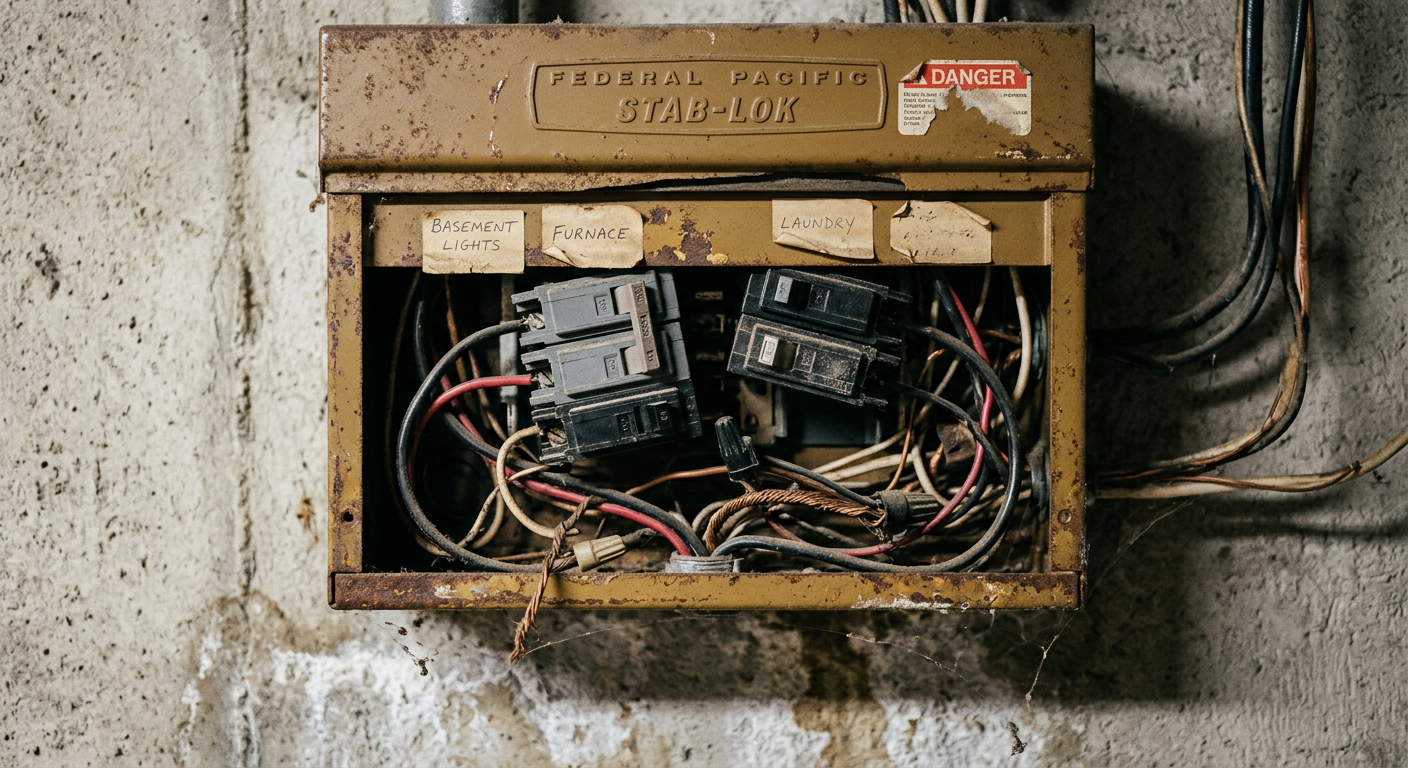
Record manufacturer, panel and breaker labels, rating and visible condition from closed covers; use qualified confirmation before making a final claim.
Observed heat, arcing, damage or water exposure changes urgency. A label without active symptoms still deserves a documented, non-alarmist plan.
State whether the meter, service conductors, disconnect, mast or underground route, grounding and service rating remain or change.
List damaged, incompatible, altered or otherwise affected circuits separately from the base panel replacement.
Confirm the legal contractor, permit result, equipment details, photos and letter or invoice the insurer will accept before work is scheduled.
If a focused breaker correction is proposed, require the exact part number, Canadian approval and panel-compatibility evidence, retained bus condition, local acceptance and reasonable future support.
Do not treat panel removal as proof that an appliance, branch circuit, water source, service fault or altered wiring that triggered the symptom has also been corrected.
Name who obtains insurer approval, grants access, holds the permit, coordinates ENMAX, pays restoration and supplies final evidence before a sale or renewal deadline.
Option matrix
The label starts the investigation. A defensible action depends on equipment identity, the source record, current condition, approved compatibility and the property-specific insurer or project objective.
| Question | Evidence | What it can establish | What it cannot establish |
|---|---|---|---|
| What is installed? | Closed-cover labels plus qualified panel, bus and breaker identification | Exact equipment family, ratings and compatibility questions | Internal condition or performance from a hallway photograph |
| What did CPSC report? | The original 1983 investigation notice and its stated limits | Historical calibration-test findings and the scope of the closure | A Canadian recall or the condition of every Calgary installation |
| Is a repair supportable? | Exact approved part, compatibility basis, bus condition and local acceptance | Whether a defined correction can resolve the documented finding | That unrelated defects or future parts availability are solved |
| What does insurance require? | Current written response for the address and exact equipment | Accepted assessment, remedy, credentials, deadline and closeout evidence | A universal rule applying to every insurer or policy |
| What replacement is proposed? | Panel and breaker schedule, circuit and service boundary, City and ENMAX plan | The actual equipment, responsibilities, outage and final records | That a panel replacement is automatically a 200A service upgrade |
Property verification
A strong Calgary record shows exactly what was installed, what each official source says, which property finding matters and how the proposed work closes that finding.
Claim to test
Proof to request
Manufacturer, panel model or catalogue information, service rating, breaker manufacturer and types, Canadian approval markings and qualified confirmation.
Decision unlocked
Which product-specific evidence, recall search and compatibility questions actually apply.
Claim to test
Proof to request
The original notice with its tested population, calibration findings, investigation limits and closure wording, kept separate from current property condition.
Decision unlocked
What historical evidence supports and which universal claims should not be made.
Claim to test
Proof to request
Exact approved part and panel compatibility evidence, bus and termination condition, scope of qualified assessment, local acceptance and future support information.
Decision unlocked
Whether focused correction can resolve the finding or full panel replacement is the supportable path.
Claim to test
Proof to request
Specified panel and breakers, circuit transfer and corrections, retained or changed service equipment, permit, ENMAX, outage, restoration, exclusions and change rules.
Decision unlocked
Whether bids describe the same property project and where additional cost can arise.
Claim to test
Proof to request
Written evidence request, accepted credentials, permit and inspection requirement, photographs, equipment schedule, invoice wording, deadline and submission responsibility.
Decision unlocked
Whether the closeout package answers the actual third-party condition.
A Calgary, Alberta-wide installed price is not a substitute for a site-specific scope. Compare the same equipment, responsibilities, exclusions, and closeout standard.
Panel model, main device, breaker count and types, surge protection, disconnect, labels and approved circuit options.
Damaged conductors, incompatible devices, poor splices, shared neutrals, grounding and corrections identified during transfer.
Meter, mast or underground raceway, service conductors, grounding, utility isolation and any separate rating change.
Working space, relocation, drywall, finishes, fire separation, hazardous-material coordination and restoration.
Inspection, insurer deadlines, utility scheduling, repeat visits, temporary needs and concealed-condition rules.
Qualified identification, compatible-part research, current recall search, insurer forms, photographs, reporting and return visits are separate professional work.
Circuit verification, labels, protective-device testing where applicable, City outcome, ENMAX record, equipment schedule, photographs, warranty and submission package.
Do not schedule around an assumed installation day until equipment, permits, utility work, inspection, outage, and restoration dependencies are known.
Photograph exterior labels, directory and visible symptoms with the cover closed, then collect inspection and insurer documents.
Have the contractor identify equipment, document accessible defects, service rating, planned loads and whether focused correction or replacement is recommended.
Name the permit holder, inspection milestone, isolation method and any ENMAX meter or service work before the outage date is set.
Normalize panel model, breakers, protective functions, circuits, service work, defects, restoration, exclusions and insurer deliverables.
Confirm equipment availability, City application, inspection readiness, ENMAX isolation or meter handling, restoration access and the response if a deficiency blocks reconnect.
Before removal, document labels, observed damage, symptoms and connected findings. After installation, record which issues were corrected and which circuits or building conditions remain outside scope.
Keep the report, photographs, permit and inspection outcome, equipment schedule, circuit directory, utility records, insurer submission, warranty and invoice.
Another qualified professional should be able to understand what existed, why the scope changed, who approved it, what was installed, and how the project closed.
Service rating, closed-cover equipment identification, observed condition, symptoms, accessible configuration, and the planned loads or project trigger.
Legal contractor, equipment, circuit and service work, permit holder, inspection, utility responsibilities, restoration, exclusions, and change-order rules.
Permit number where required, approved equipment, labelled circuits, documented changes, inspection milestones, and utility instructions where applicable.
Final acceptance or inspection status, equipment information, settings, warranty, utility records, paid invoice, and the responsible contractor's contact details.
Continue researching
Plan the local equipment, permit, outage and closeout scope.
Open guideReview the evidence, inspection boundary and replacement decisions in depth.
Open guideTranslate insurer wording into defined evidence and deliverables.
Open guideReview the broader City and ENMAX project sequence.
Open guideRead the CPSC record, identification and insurer evidence in depth.
Open guideCompare legacy equipment families without brand-only conclusions.
Open guideNormalize City, ENMAX, equipment, circuit and restoration costs.
Open guideUse the parallel local framework for older fuse equipment.
Open guidePrimary references
Forms, code editions, inspection procedures, utility standards, equipment, and incentive programs can change. Verify the current local rule before relying on a project detail.
Canadian questions
Do not describe the CPSC action as a universal recall. Its notice says testing confirmed certain calibration failures, but the investigation was closed without a determination that the available data established a serious risk of injury.
A qualified assessment should identify the exact equipment, condition, alterations, symptoms, parts availability and insurer requirements. Many owners choose replacement, but the recommendation should be documented for the property.
No. Do not create an overload, remove the cover or touch energized equipment. Record symptoms and arrange qualified assessment.
No. A panel can be replaced at the existing service rating. A 200A service requires separate load, equipment, route and utility evidence.
Some insurers impose equipment-specific conditions, while others ask for an electrical report. Obtain the exact written requirement and acceptable closeout evidence.
Panel replacement is regulated electrical work. Confirm the City permit category, eligible holder and inspection requirements before work begins.
Cost depends on panel and breakers, affected circuits, service equipment, City and ENMAX steps, access, restoration and documentation. Compare one itemized scope.
Smoke, arcing, melting, burning odour, severe heat, water exposure, physical damage or unreliable operation warrants prompt professional or emergency guidance. Avoid repeated resets.
Related names can appear on different equipment and markets, but the exact manufacturer, panel series, breaker type, ratings and approval information still need confirmation. Do not transfer a product-specific finding from one label to every similarly named panel.
Handle colour can support screening but is not complete identification. Record the enclosure and breaker labels and have the installed combination confirmed before applying product-specific evidence or choosing parts.
Do not use a blanket statement. The question is whether the exact installed or proposed equipment is approved, compatible, in suitable condition and acceptable under current local requirements. Search current recalls by exact model and date information.
A focused correction requires an exact approved compatible part, suitable retained enclosure and bus condition, local acceptance and a finding that the repair resolves the problem. A physically fitting marketplace part is not enough evidence.
A useful report documents equipment identity, scope and limitations, observed condition, compatibility, defects and recommendations. It should not promise future performance or an insurer decision. Ask the insurer what report and credentials it accepts.
The physical panel change may fit within a planned outage, but equipment, City permit, ENMAX coordination, circuit investigation, inspection, correction and insurer closeout determine the full timeline. Treat a same-day reconnect as a gated plan, not a guarantee.
Request exact identification, qualified condition findings, insurer input and a complete option price during the applicable review period. If work is completed, obtain permit and inspection status, equipment schedule, circuit directory, photographs, warranty and paid invoice.
Property-specific next step
Send the property location, panel details, project trigger, planned loads, and timing. Provider availability, licensing, scope, price, permit responsibility, and utility scheduling are confirmed before work is booked.