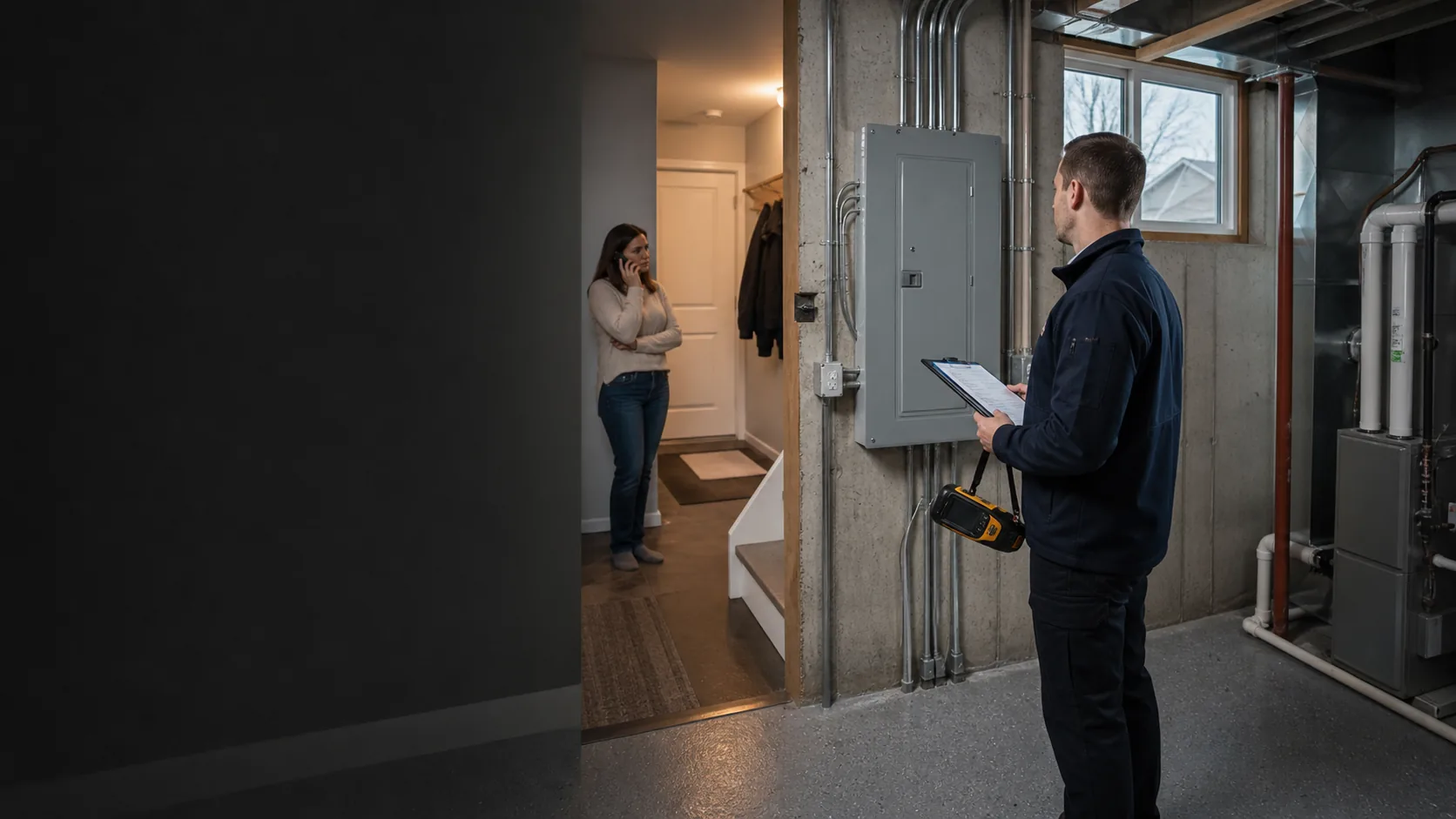
Decide whether the next call is 911, ENMAX or a licensed electrical contractor, then document repair, permit, inspection and safe-restoration evidence without approaching the hazard.
Who to call for an electrical emergency in Calgary
Call 911 for fire, visible smoke, active arcing, a downed line, serious electrical shock or immediate danger. Report a Calgary utility outage or electrical trouble to ENMAX at 403-514-6100. Use a licensed and registered electrical contractor for faults on customer-owned equipment after immediate danger is controlled. Service damage can require all three paths: emergency scene control, ENMAX isolation, and contractor repair under the applicable City permit and inspection process.
The safe next action depends on the strongest warning sign, not the most convenient provider. A contractor cannot replace fire or medical response, and ENMAX does not repair every customer-owned panel or branch circuit. When ownership is uncertain, describe the visible condition without opening the meter, panel or service equipment.
Immediate emergency
911 from a safe location
Fire, visible smoke, active arcing, explosion, downed line, serious shock, immediate danger or a condition that is rapidly worsening
Warn others, leave by a safe route, keep clear and follow the emergency communications officer's instructions.
Utility trouble
ENMAX Trouble: 403-514-6100
Area outage, damaged utility line, tree on a line without imminent danger, suspected supply failure or utility-owned equipment concern
Use the outage map and trouble channel from a safe place. Do not touch the meter, service conductors, poles or damaged objects.
Urgent electrical assessment
Licensed and registered electrical contractor
Burning odour without smoke, abnormal heat, repeated tripping, buzzing, severe flicker, partial power, wet customer equipment or an unresolved fault
Describe the symptoms, keep affected equipment unused and confirm what must remain off until the responder attends.
Documented repair and restoration
Contractor, City and ENMAX as the scope requires
Damage has been isolated and the remaining decision is repair, permit, inspection, reconnection, insurer evidence or prevention of recurrence
Separate temporary make-safe work from the permanent correction and retain every approval and closeout record.
Calgary responder router
Route the danger before diagnosing the equipment
Choose what you can observe without approaching the hazard. This conservative tool routes the next contact; it does not diagnose, dispatch or declare equipment safe.
Conservative route
Call 911 / keep clear
Treat changing heat, smoke, arcing or worsening conditions as 911 emergencies. Otherwise keep clear and request urgent qualified assessment.
If you are unsure whether the situation is an emergency, the City of Calgary says it is better to call 911 and let the emergency communications officer decide.
Symptom-to-responder matrix
Match the first action to the strongest observable sign
This table is deliberately conservative. It routes contact and boundaries; it does not identify the electrical cause or clear equipment for use.
Observable sign
First action
Likely responder path
Do not
Smoke, flame or active arcing
Leave and call 911
Calgary Fire / emergency services; ENMAX may isolate utility supply
Do not use water, open the panel, operate a breaker or return to investigate.
Electrical shock or electrocution
Call 911 for serious symptoms or immediate danger
Emergency medical response, followed by electrical investigation when the scene is safe
Do not touch someone who may still be connected to an energized source.
Downed, exposed or sparking powerline
Keep well away and call 911
Emergency services and ENMAX
Do not touch nearby vehicles, fences, trees, puddles or objects that could be energized.
Burning odour, heat or crackling at a panel
Keep clear; escalate to 911 if changing, smoking, arcing or dangerous
Urgent qualified electrical assessment after immediate danger is ruled out
Do not remove the cover or repeatedly load equipment to reproduce the symptom.
Breaker repeatedly trips
Leave the affected circuit off
Qualified electrical diagnosis; appliance service may follow when the fault is isolated to equipment
Do not keep resetting, install a larger breaker or bypass protection.
Partial power, severe flicker or unusual bright/dim lights
Report the pattern without opening equipment
ENMAX when supply trouble is possible and a contractor for customer-owned equipment
Do not assume a normal branch-circuit trip or continue using sensitive loads.
Water, flood or leak near electrical equipment
Keep out of the wet area
Emergency services or ENMAX for immediate danger, then qualified isolation, damage assessment and restoration
Do not enter water to reach a switch, breaker, pump, cord, appliance or panel.
Whole property outage with no visible damage
Check the ENMAX outage map from a safe location
ENMAX Trouble; contractor if the utility excludes its system or customer equipment is implicated
Do not open the meter or service equipment to identify ownership.
Do not escalate the hazard
Actions an emergency guide should never encourage
The absence of visible flame does not make energized, wet, heat-damaged or service-side equipment safe to approach.
Do not open a panel, meter base, disconnect or damaged enclosure to investigate.
Do not use water on energized equipment or enter standing water to reach a switch.
Do not touch a person who may still be connected to an energized source.
Do not repeatedly reset a breaker, replace it with a higher rating or defeat protection.
Do not touch a downed line or anything it may energize, including vehicles and fences.
Do not backfeed a house through a receptacle with a portable generator.
Do not assume the main breaker isolates utility conductors ahead of the service disconnect.
Do not re-energize fire-, water-, impact- or abnormal-voltage-damaged equipment on appearance alone.
Ownership and control
ENMAX, contractor, City or emergency services?
The physical location of a symptom does not always reveal the legal ownership boundary. Route the visible condition first and let the responsible parties coordinate isolation and repair.
01
Street, pole and distribution line
Lead: ENMAX
Evidence: Outage record, trouble report, crew instructions and restoration notice
911 remains first for a downed, sparking, burning or immediately dangerous line.
02
Service drop, mast, meter and service connection
Lead: ENMAX plus a registered electrical contractor
The boundary can split across components; neither the homeowner nor an unapproved contractor should handle the meter or utility connection.
03
Main disconnect, panel, feeders and branch circuits
Lead: Licensed and registered electrical contractor
Evidence: Diagnosis, make-safe record, repair scope, permit where required, inspection and test results
Utility isolation can still be required when the work cannot be completed safely on the customer side alone.
04
Plug-in appliance or device
Lead: Qualified electrical or appliance professional according to the fault
Evidence: Affected circuit, product identity, approval mark, recall check, diagnosis and replacement or repair record
Smoke, shock, fire, damaged wiring or a recurring circuit fault expands the scope beyond the appliance itself.
05
Fire, flood, impact or insured loss
Lead: Emergency responder, insurer, contractor, City, ENMAX or forensic specialist as assigned
Evidence: Incident number, scene restrictions, photographs taken safely, damage boundary, repair authorization and re-energization evidence
Preserve evidence when safe, but never delay emergency action or disturb equipment to improve a claim file.
Whole-house or area outage
Check ENMAX's current outage information without approaching service equipment. Look only for safe context such as whether neighbours or streetlights are also out. Visible damage, a downed conductor, fire or sparking changes the route to 911.
Property-only or partial power
A service connection, meter interface, main, feeder, branch circuit or customer equipment could be involved. Severe flicker, abnormal brightening or dimming, heat and odour are important urgency clues. Report them exactly; do not open equipment to narrow the cause.
Water, storm or impact damage
Keep outside the exposure area. Equipment that looks dry can retain contamination, corrosion or hidden damage. Define the entire affected boundary and require qualified isolation, testing, repair and authorization before restoration.
Conditions that expand the response
Buildings and equipment with more than one control boundary
The first safety route stays the same, but ownership, isolation and restoration become more complex when common property, temporary generation, stored energy, major loads or severe weather are involved.
Condominium, apartment or rental building
Determine whether the affected equipment serves one unit, common property or the whole building without entering electrical rooms or opening distribution equipment. Use 911 for immediate danger, notify the property manager or building emergency contact, and preserve the suite, common-area and utility incident records separately. A unit owner or tenant may not control access, isolation, permit decisions or the building's service equipment.
Portable generator during an outage
Operate portable generators outdoors where exhaust cannot enter the building and follow the manufacturer's clearances and fuel instructions. Never connect a generator to home wiring by backfeeding a receptacle. Supplying building circuits requires approved transfer equipment and a compliant installation. Before relying on temporary generation, identify essential loads, starting current, fuel duration, carbon-monoxide controls and the safe return to utility power.
Solar, battery or bidirectional equipment
A utility outage does not prove every conductor or energy source is de-energized. Solar photovoltaic, storage, vehicle-to-home and backup systems can introduce multiple isolation points and operating modes. Tell emergency responders, ENMAX and the contractor exactly what equipment is installed. Retain shutdown documentation and require the qualified restoration process for every source rather than treating the main panel as the only energy boundary.
EV charger, hot tub or high-load appliance
A repeated trip or heat event during one large load can involve the appliance, branch circuit, disconnect, feeder, panel connection, service capacity or an energy-management control. Leave the affected equipment unused and report the exact operating state, configured current, weather and recent changes. Do not reduce protection, bypass a controller or assume the visible device is the only damaged component.
Winter outage and heating continuity
Calgary cold can turn a long outage into a building-protection and occupant-safety problem. Follow ENMAX restoration information and emergency instructions, protect vulnerable occupants, and use only approved heating and backup-power methods. Do not use outdoor combustion equipment inside. After frozen pipes, leaks or condensation expose electrical equipment, keep the affected area isolated until qualified assessment addresses both moisture and electrical damage.
Product failure or recall suspicion
Record the product brand, model, serial number, approval mark and incident details only when safe. Search the federal recalls and safety-alert database and follow the manufacturer or regulator's remedy. A recall lookup complements, but does not replace, scene control and electrical diagnosis. Do not continue operating suspect equipment to collect video or prove that the failure repeats.
Eight-stage Calgary repair and safe-restoration process
Emergency attendance can end the immediate danger without completing the permanent repair. A defensible recovery record connects scene control to ownership, diagnosis, permit, inspection, reconnection and final acceptance.
STEP 1
Protect people and establish scene control
Use 911 for life, fire, downed-line or immediate danger. Keep people outside the affected zone and follow responder instructions. A website form, quote request or contractor callback is never the first action when the condition is active and dangerous.
STEP 2
Identify the authority and utility boundary
Record whether the issue involves a public line, service connection, meter, main equipment, branch circuit or appliance without opening anything. ENMAX owns and controls utility equipment; customer equipment requires a qualified electrical contractor.
STEP 3
Document the make-safe state
After the scene is controlled, record who attended, incident or trouble numbers, what was isolated, which equipment must remain off, temporary restrictions and who can authorize the next stage. Do not rely on a verbal handoff alone.
STEP 4
Define the damage and diagnostic scope
Specify the event, affected areas, equipment, recent work, operating conditions and unresolved symptoms. Fire, water, impact and abnormal-voltage events may require broader assessment than replacing the first visibly damaged part.
STEP 5
Separate temporary and permanent work
A temporary disconnection, capped circuit or isolated load can control risk without completing the permanent repair. The written scope should state what remains unsafe, what can operate and what correction is still required.
STEP 6
Complete permit, inspection and utility steps
The City states damaged electrical services must be repaired by a licensed and registered electrical contractor holding the required permit. ENMAX meter-handling and disconnect or reconnect procedures also apply when utility isolation is involved.
STEP 7
Verify before re-energization
Use the qualified tests, authority outcome and utility authorization required for the actual equipment and event. Dry appearance, a reset breaker, replaced fuse or temporary restoration does not by itself prove all affected equipment is safe.
STEP 8
Close the evidence file
Retain the diagnosis, photographs, permit number, inspection outcome, accepted verification, ENMAX records, invoices, equipment model details, warranties and insurer acceptance. These records support future sale, insurance and recurrence investigation.
Emergency electrician Calgary quotes
Normalize the dispatch before authorizing it
Do not let immediate concern erase basic provider verification. Confirm identity, charges and limits without delaying 911 or ENMAX when those are the correct first contacts.
Question
Written evidence
Why it matters
Who is responding?
Legal contractor name, City business licence, responsible Master Electrician and person arriving
A marketplace profile or phone number is not the regulated contracting entity.
Power being back on is an operating state, not a complete evidence package.
Make-safe cost
Attendance, diagnosis, isolation, temporary protection and after-hours charges needed to control the immediate risk.
Permanent repair cost
Equipment, labour, design, permit, inspection, utility coordination, restoration and return visits for the final correction.
Uncertainty allowance
Concealed damage, unavailable parts, utility findings, insurer requirements and expanded scope discovered after safe access.
Emergency evidence packet
Collect records after people are safe and only from a safe location. The goal is a chain from incident to authorized restoration, not a photo collection that requires approaching damaged equipment.
Address, date, time, weather and the first observable warning sign
911, Calgary Fire, ENMAX, insurer or contractor incident and trouble numbers
Who isolated what, the exact equipment left off and access restrictions
Legal contractor, responsible Master Electrician, permit number and declared scope
Qualified findings, measurements, photographs, affected-equipment list and limitations
Temporary make-safe record separated from permanent repair and remaining work
City inspection outcome, accepted verification or reinspection and final permit record
ENMAX disconnect, reconnect or service authorization and restoration time
Invoices, model and serial details, approval marks, recall checks and warranties
Insurer, lender, buyer or property-manager acceptance when a third party is involved
Primary source library
Verify the current Calgary emergency and restoration path
Emergency contacts and authority requirements can change. These links point to the public bodies that control the relevant decision.
Who should I call for an electrical emergency in Calgary?
Call 911 from a safe location for fire, visible smoke, active arcing, a downed line, serious electrical shock or immediate danger. ENMAX directs Calgary outage and electrical-trouble reports to 403-514-6100. A licensed and registered electrical contractor handles customer-owned equipment after immediate danger is controlled. ElectricalPanels.ca provides education and request routing, not guaranteed emergency dispatch.
Is an emergency electrician the same as ENMAX?
No. ENMAX controls utility distribution, outage response, meters and specified service connections. A registered electrical contractor works on customer-owned installations within its authorization and permit scope. Service damage can require both parties, plus City inspection or emergency services. Confirm the ownership boundary before assuming one responder can complete every step.
What should I do if my Calgary electrical panel smells like it is burning?
Keep away from the panel and do not remove the cover. If there is smoke, active arcing, severe heat, fire or immediate danger, leave and call 911. If the condition is not immediately dangerous, stop using affected equipment only when this can be done without approaching the hazard and request urgent qualified assessment. Do not repeatedly operate loads to reproduce the odour.
Should I turn off the main breaker during an electrical emergency?
Generic advice to operate the main can be unsafe when the panel is hot, wet, damaged, smoking, arcing or difficult to reach. Keep clear and follow emergency, utility or qualified responder instructions. A main disconnect also may not isolate utility-side conductors ahead of it.
Why should I not keep resetting a breaker that trips?
The breaker is responding to an unresolved condition such as overload, appliance failure, wiring fault, moisture, a poor connection or a protection-device issue. Repeated resetting can re-energize the fault without correcting it. Leave the affected circuit off and have the cause diagnosed; heat, odour, shock, smoke or crackling raises the urgency.
My neighbours have power but my Calgary house does not. Who owns the problem?
A property-only outage can still involve the ENMAX service connection, meter interface, main equipment or customer-owned wiring. Report the pattern to ENMAX without touching service equipment. If ENMAX excludes its system, a registered electrical contractor can investigate customer-owned equipment. Partial power, severe flicker or unusual bright and dim lights should be reported promptly.
What if a powerline is down or a tree is touching it?
Keep everyone well away. The City lists a downed powerline as a reason to call 911, and ENMAX says to call 911 when a powerline is sparking, burning, on the ground, dug up or exposed. For a tree on a line without imminent danger, current Calgary Fire guidance also identifies ENMAX Trouble at 403-514-6100. Do not touch the tree, fence, vehicle or nearby object.
What should I do after an electrical shock?
Do not touch a person who may still be connected to an energized source. Call 911 for loss of consciousness, serious symptoms or immediate danger and follow medical instructions. MyHealth Alberta notes that electrical shock can affect internal tissue, the heart and lungs even when visible injury seems limited. Use 811 or a healthcare professional for non-emergency medical guidance as directed.
Can I enter a flooded basement to turn off the panel?
Do not enter standing water to reach a panel, breaker, switch, pump, cord or appliance. Keep away from wet electrical equipment and contact emergency services or ENMAX when there is immediate or utility-side danger. Qualified isolation and damage assessment must come before normal cleanup or re-energization.
Does an emergency electrical repair in Calgary need a permit?
The exact work controls the requirement. The City states that when an electrical service is damaged, repairs must be completed by a licensed and registered electrical contractor holding an electrical permit. Other wiring repairs or replacements may also require permits and inspections. The contractor should identify the permit category, holder, inspection stage and closeout record in writing.
Can ENMAX reconnect power immediately after service damage?
Not necessarily. ENMAX's disconnect and reconnect guidance says a permit number, completed inspection or City authorization may be required before reconnection. Emergency response priorities, equipment condition, contractor repair, inspection availability and utility scheduling can affect timing. Ask for the current sequence for the actual address and service.
How fast can an emergency electrician arrive in Calgary?
Arrival depends on the provider, location, weather, road conditions, active demand, parts and whether emergency services or ENMAX must first secure the scene. This website does not promise a response time or operate a 24/7 dispatch centre. Confirm the legal provider, arrival window, call-out charge and work limits directly before authorizing attendance.
How much does an emergency electrician cost in Calgary?
There is no reliable universal page price. The bill can include call-out, travel, minimum labour, after-hours premium, diagnosis, temporary isolation, parts, permit, inspection, ENMAX coordination, return visits and restoration. Ask for those components separately and distinguish the cost to make safe from the cost of permanent repair.
What records should I keep after an electrical fire, outage or service repair?
Keep 911, fire, ENMAX or insurer incident references; photographs taken only when safe; the diagnosis and affected-equipment list; make-safe restrictions; legal contractor and permit information; City outcome; ENMAX reconnect authorization; test results; invoices; product model details; warranties; and third-party acceptance. Record what remains isolated and who can authorize re-energization.
Can ElectricalPanels.ca tell me remotely that the equipment is safe?
No. The page can help route the next contact and prepare evidence, but it cannot inspect the scene, test equipment, establish utility ownership, provide medical advice, issue a permit outcome or authorize re-energization. Use 911, ENMAX, the City, healthcare professionals and qualified contractors for their respective decisions.
Continue with the right Calgary evidence guide
Once immediate danger is controlled, move into diagnosis, repair planning and permit closeout without losing the incident record.
Send the property location, panel details, project trigger, planned loads, and timing. Provider availability, licensing, scope, price, permit responsibility, and utility scheduling are confirmed before work is booked.